REFERENCES
TRANSCRIPT
Lewis Weiss (00:02.581)
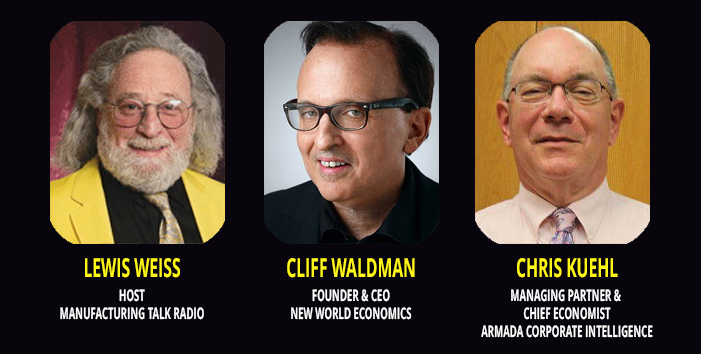
Good day, everyone. This is Lew Weiss from Manufacturing Talk Radio. And we’re here today with Cliff Waldman from World Economics and Chris Kiel from Armada Corporate Intelligence, which is sort of an oxymoron. We’re going to be talking today about
Cliff (00:15.138)
The World Economics.
Lewis Weiss (00:32.331)
The two reports, one being the Federal Reserve Statistical Release that came out this morning and the ISM report that comes out at the beginning of the month. We’re going to talk about the comparisons of the two and very salient points about what these two reports are reporting and things are actually looking good. And so we’re going to talk about that.
End of the show, if you’d like, these two reports are going to be on the Manufacturing Talk Radio website, and you can print it down from our website. Two of them will be there on the homepage of our website. So, gentlemen, Cliff, you’re up first.
Chris Kuehl (01:14.591)
you
Chris Kuehl (01:23.287)
You
Cliff (01:25.326)
You know, these are two extremely valuable reports. I can only suggest to everybody out there who has some interest of any kind of following manufacturing, both are essential items in your toolkit. So, you know, I follow them very carefully every month. What’s interesting about doing the show right now is that this is a bit of an event. U.S. manufacturing has been weak for the better part of a year now. It’s just it’s been in what can legitimately be called a manufacturing slump for some
Finally, we’re starting to see some light at the end of that tunnel. The Federal Reserve Statistical released a January Industrial Production Report. remember, industrial production is manufacturing, mining, and utilities. The manufacturing data there has suggested we’re strong, 0.8 % on month over month. And it was broad-based.
Chris Kuehl (02:19.605)
Mm-hmm.
Cliff (02:25.136)
saw a strength in durable goods, in machinery, in autos. We saw a strength in non-durable goods, chemicals, plastics and rubbers and things like that. And the ISM number, which since 1931 has been a very good foreshadowing tool for what manufacturing activity may look like in the next two to three months, that too jumped nicely. It jumped over that critical 50 mark, which is demarcation between
Chris Kuehl (02:31.639)
This is rain.
Chris Kuehl (02:52.671)
Mm-hmm.
Cliff (02:55.056)
contraction in the manufacturing sector ahead or growth in the manufacturing sector ahead. Both looking better. Now, you want to be careful here. Very often, you we’ve been in protracted slums. You know, sometimes there are pop-ups and data during slums. Also,
The Institute for Supply Management puts on member comments on the survey, which I find to be very valuable. The member comments were still sanguine. The members are still telling us that not only the tariffs, but the chaotic nature of the way the tariffs are being applied is hurting them. So there was a kind of negativity there. So I’m enthusiastic by both reports, but
caution, but I think a measure of caution is very much warranted, at least for a few months.
Lewis Weiss (03:51.915)
I think it’s mentioning that the ISM index number was 52.7, which was the highest, not only the highest in a year, but I think it’s the only month that it was over 50, which indicates expansion, and below 50 is contraction. So that’s quite significant.
Chris Kuehl (03:51.999)
yeah i i’m i can’t
Chris Kuehl (03:58.775)
.
Cliff (04:14.638)
contraction.
Chris Kuehl (04:18.487)
Yeah, it is. And we don’t want to get overly carried away. 52 is not huge. We can slip back under 50, and we have in previous months. One of the things I was going to point out is some of the other research that pops up that reinforces some of the messages from both of these reports. I’m the economist for the Fabricators and Manufacturers Association, and they do a thing every quarter.
called the FFJSER, Worst Acronym in Human History. Absolutely impossible to pronounce, but it’s the Forming and Fabricating Job Shop Consumption Report. So it’s aimed at much smaller companies, which is kind of the focus of FMA. What was interesting in that report, and this has been going on now for two or three quarters, are the number of responses that are saying, this is how far out we’re pushing our capital spending plans.
and for quite a while it was we’re not going to do this for six months we’re not going to do it for a year we’re stalled we don’t quite know what’s going on with tariffs just this last quarter you suddenly saw them pushing up their capital spending to current quarter and they’re saying look we’ve waited about as long as we can we don’t really want to lose business over this but just as clif was saying the comments
were indicative because people were saying look the thing that is still keeping us uneasy is we don’t know what anything costs and we’re hesitant to go forward and buy something particularly a commodity if that commodity then changes price because our competitor who waited may be able to miss the tariff. I mean we’ve just seen a decision made to lower tariffs on some aluminum some steel products
particularly those that are aimed at the consumer. Well, if you’re a purchaser of steel and aluminum, it’s like, well, gee thanks, because I bought it a month ago and now my competitor is buying it now cheaper. Gee, I wonder who has the competitive edge. It won’t be me. I was just talking to a conference water and sewer distributors. Most of their products, most of their work is done for institutions, for cities, for
Lewis Weiss (06:31.827)
you
Chris Kuehl (06:38.005)
hospitals whatever they don’t have budget flexibility so if their price changes their clients as well gee that’s a shame guess you’re gonna have to eat that are you and that can be very discouraging to a business
Lewis Weiss (06:54.155)
Cliff, any comments to that?
Cliff (06:59.15)
Well, I’ll extend the chaos a bit globally.
Chris Kuehl (07:04.31)
Yeah.
Cliff (07:04.83)
I mean, the global economy is all over the place. It is almost hard to put it as one picture. China, and I’ve been talking about concerns with China for some time now, China is split. Its external momentum is still strong. Its internal momentum is a big source of concern. The Chinese consumer matters and will continue to matter and matter more and more for the global economy. The Chinese consumer is weak now. They had a property bubble bust.
Chris Kuehl (07:24.822)
Right.
Cliff (07:34.656)
different than what would happen in the West for several reasons, but one of which is they have a much higher savings rate, a much higher cushion. But nevertheless, a property bubble bust that is badly impacting their consumer spending along with other things. Europe’s doing a bit better than expected. you have to take that statement in Europe with a grain of salt because the European economy hasn’t been living up to any kind of potential for quite some time now.
Also the geopolitical issues because they affect in the global economy are massive. They affect supply chains. We don’t know what’s going to happen with Iran. We don’t know what’s going to happen with Ukraine. We don’t know what’s going to happen with Venezuela, you know, which is an open wound in in you know, the southern part of this hemisphere. We don’t know how that’s going to play. All those things have physical impacts on manufacturing because they affect supply chains. So
Chris Kuehl (08:13.312)
Mm-hmm.
Cliff (08:34.641)
I’m going to take Chris’s point and I’m going to say it’s a global uncertainty right now.
Chris Kuehl (08:39.627)
Yeah, I agree. I agree completely. I the Fed’s supply chain pressures index has gotten worse in the last month or so. Nothing like it was a couple years ago. We’re not dealing with Panama Canal and Red Sea and all that stuff. But you’ve got capacity issues. You’ve got supply coming out of Asia. Same thing. They don’t really know where they’re going to sell this and who’s going to buy it. You start to look at some of the other international issues and
You’re right, it’s a very integrated economy and one of the challenges with the tariff policies, ideally when you put a tariff in place you have that product produced domestically. So you can push your consumer to consume the domestic version. But if you put a tariff on something that you don’t produce, it just ends up being more expensive and you’re still going to have to get it from another country. China is right now in the middle of Lunar New Year.
Lewis Weiss (09:18.091)
Thank
Chris Kuehl (09:38.391)
and the entire country is staring at that going boy i sure hope that the year of the fire horse is better than the year of the snake it’s a huge huge driver for their consumer society
Lewis Weiss (09:51.819)
Well, there’s an interesting comment to make about China and their exports to the United States over the last year has plummeted. I don’t remember the exact number. I think it’s somewhere around 40 % reduction in exports to the US, which is huge, huge number. However, the Europeans have been sending over trade groups from Europe to China and they’re looking to make deals.
Chris Kuehl (10:01.643)
Mm-hmm.
Lewis Weiss (10:21.773)
So we may have cut our own throats and we’re getting used to doing that.
Chris Kuehl (10:26.187)
Hmm.
well be aware that uh… chinese manufacturers not gonna sit there and say oh gee i lost my market i guess i’ll close shop we have seen the exports from china come down we’ve seen exports from other countries go up because the chinese are saying oh heck we’ll just make part of it in vietnam or thailand or philippines or indonesia or mexico or you know i mean i saw a stock with the manufacturer the other day
Lewis Weiss (10:36.491)
Thank
Lewis Weiss (10:48.479)
That’s true.
Chris Kuehl (10:56.159)
I didn’t even know there was a country called Sri Lanka but now I’m getting stuff from them.
Cliff (11:00.75)
It’s got to be a wake-up call to US policymakers to realize that China may not need us as much as, you know, for their export strength. That has got to be of concern to responsible economic policymakers in the US.
Lewis Weiss (11:01.073)
you
Chris Kuehl (11:18.347)
Yeah, it really is.
Lewis Weiss (11:18.421)
But we did this to ourselves.
Chris Kuehl (11:21.429)
Well, it’s understanding the balance between the producer and the consumer. know, who really has the upper hand? And frankly, we’ve had the upper hand because we consume like no other country on earth. But if you’re targeting a consumer society in a country that has suddenly discovered the joys of consumption, we have a new situation in Japan. The new prime minister there is kind of revisiting Shinzo Abe’s
expansion policies and is trying to get the Japanese to buy more stuff and the Chinese are like by all means why don’t we give you some more stuff for you to buy. So that’s an interesting dynamic because Japan is trying to figure out what kind of leverage it has over China. In Turkey she is not a big fan of China, she’s a populist politician.
By the way, she was a drummer for a heavy metal band that I find very interesting.
Lewis Weiss (12:20.779)
What do you think about the possibilities, you know, we’re talking about the global aspect, what do you think about the possibilities that all of this exporting from China to other countries because everyone’s gotten smarter and we may not have been, how is that going to ultimately affect our manufacturing sector for our exports?
Chris Kuehl (12:45.887)
It could have a positive effect, on the relationships, but the challenge for the US has been that most of the manufacturers in this country are fairly small and it’s difficult for them to make those contacts internationally unless they get help. So, like the guy that I was talking to that was suddenly doing business in Sri Lanka, how did that come up? Well, some guy from Sri Lanka showed up at a trade show and they shared a beer.
Lewis Weiss (12:57.354)
Right.
Chris Kuehl (13:13.835)
and and suddenly he has a new market in shalaka but that’s pretty accidental
Lewis Weiss (13:17.696)
Right.
Cliff (13:21.26)
The one thing I…
While I’m concerned about China in terms of its relations with the US and particularly US manufacturing, I have to say an even bigger concern actually in light of what the adjustments we’re seeing out of China is Canada. I cannot tell you how much we are shooting ourselves in the foot by making an enemy, not quite an enemy, but an adversary out of Canada. There are millions of US jobs, but quite a few US manufacturing jobs
Chris Kuehl (13:37.119)
Mhm.
Cliff (13:52.5)
that are dependent on exports to Canada. Now, I don’t necessarily see that going away entirely, but why are we risking one of, certainly one of the most important economic relationships? And it’s not just an economic relationship of selling finished goods. It’s an economic relationship that, of selling finished goods along with the health of our critical supply chains. Auto, you know, the auto…
Chris Kuehl (14:17.575)
Right. I mean, we get an awful lot of stuff from Canada. You know, we…
Cliff (14:21.334)
The obvious one. That is a very short-sighted thing to do. I think we need Canada more than we need China right now in terms of keeping our economic health and particularly keeping our manufacturing and our trade health.
Chris Kuehl (14:41.047)
Yeah, I mean we made a deliberate decision twenty-few-and-a-side years ago to try to create in North America what the Europeans had created with the European Union. So we were being very upfront at that point saying we want to unite Canada, the U.S. and Mexico. It made perfect sense. The resources from Canada, the talent and manufacturing skills in the U.S., the labor force in Mexico, what could be better? And now we’ve set about alienating our two partners and it’s like why?
to what to what extent i mean europe is still enjoying their european union ha asia is coming closer and closer to china despite the fact that they don’t really trust china i mean a lot of these countries would rather not to be as close as they are but they don’t have a lot of choice lately you know i think you kind of the the word of the day right now is short-sighted we’re just not thinking ahead
Most businesses don’t have the luxury of being short-sighted. They have to think ahead.
Lewis Weiss (15:43.061)
considering that Canada is our United States largest market. And it is more than just short-sighted. It is just plain absurd.
Chris Kuehl (15:51.816)
Mm-hmm.
Chris Kuehl (15:59.767)
It is, and it’s understanding also that Canada is a very diverse country. The fact that we don’t look at it that way, we kind of underestimate China, but for example, Alberta has been looking for years to almost cut ties with Canada. know, they want to, there’s an independence movement there. It’s not going to succeed, I don’t think, but…
there’s a market difference between the canadians in ontario and quebec and those that are in sisketsia on manitoba and alberta and british columbia is practically its own universe
Lewis Weiss (16:38.699)
in the French Quebec. They’ve been wanting to leave forever.
Chris Kuehl (16:38.806)
you
Chris Kuehl (16:43.997)
yeah i mean you know yeah yeah all you have to do is learn five hundred year old french and you’re set to go
Lewis Weiss (16:51.179)
Meanwhile, the province of Ontario represents 60 % of the Canadian economy, both in manufacturing and consumer goods and export. So they still hold all the cards as one might say.
Chris Kuehl (16:59.553)
Mm-hmm.
Chris Kuehl (17:07.735)
Yeah, I mean it’s as a consumer oriented country, we have to be cognizant of where that production comes from. I mean the fact that we’ve had low tariffs on countries for years was deliberate. We did this after Second World War trying to rebuild the world economy because we wanted to buy what they were producing and all of that stuff. We did it to make the consumer in the US king. We’ve always had access to the best stuff in the world at the best prices in the world.
but it came at a cost. We lost a lot of manufacturing capability. It is justifiable to try to bring some of that back, but not cutting off your nose to spite your face.
Lewis Weiss (17:50.421)
So where do you see this going down the road in 2026?
Cliff (17:55.34)
I think 26 is going to be more, as I said the last time, it’s going be more or less of continuation.
maybe a little bit more firmness in the outlook, as shown by today’s data that we’re talking about today, is a continuation of the uncertainty that was propagated throughout 2025. We have these trade matters that are significant for our manufacturing sector. We don’t know where AI is going. AI, I saw a cartoon somewhere that, you know, they ask CEOs,
Chris Kuehl (18:14.038)
Hm-hm.
Cliff (18:33.529)
you
What do you want to do with AI? We don’t know. When do you want to do it? Right now. And that seems to be the situation. that among other things, that creates financial uncertainties because we’re investing just insane amounts of money into AI. we don’t… I just wonder how well it’s being thought out. I’d like to find out, they doing it as a
Chris Kuehl (18:37.985)
Ha
Chris Kuehl (18:48.331)
Mm-hmm.
Cliff (19:04.398)
labor substitute, a labor supplement? Have they thought about it in that way? Because particularly for the manufacturing sector, one of the things that if we really wanted, if this president particularly really wants to strengthen our manufacturing sector, his first line of attack should be the workforce. We need to invest in our man. That’s that if you want to if you want to be a leader who focuses on manufacturing, we have got to invest in a workforce that we are
Chris Kuehl (19:24.82)
Right.
Lewis Weiss (19:27.05)
Yeah.
Cliff (19:34.358)
very short on. We are short on engineers. We are short on scientists. We are short on… Try ask a CEO of a manufacturing company how easy it is to get a tool maker or a die maker or anything. They can’t do it.
Chris Kuehl (19:46.795)
Hm
no exactly i mean i was talking to a manufacturer just about two weeks ago and he was very excited because he had just hired a senior machine as he’d been looking for for almost a year and he said the best part he was one of the younger applicants he was only seventy eight and and it’s kind of like holy cow because the number one way that manufacturers are hiring now is bringing people out of retirement and poaching each other you know i’ve
Lewis Weiss (20:05.734)
Yeah.
Chris Kuehl (20:16.627)
I’ve encountered trade shows now where the companies are not allowing their operators to go to the trade show because they’re afraid they’re going to get poached. And I was at one not long ago where day one he had a Mitsubishi hat on, day three it was a Mazak hat. I said, what happened? Got a new job. And it’s like, so it’s become highly competitive. And when it comes to AI, you know, AI is,
data analysis. It’s in the comments that I’m hearing from people that are doing it is that, okay, we have invested, it’s like drinking from a fire hose. We have all this information, but we still need to know what to do with it. You know, we know a lot more about our customers than we ever did before. We know a lot more about our process than we ever did before. Now what? You know, what, what am I going to do to change what I do just because I know this?
Lewis Weiss (21:09.321)
You touched on the skill gap issue that we have here in this country and the fact that kids have been going to college and running up a $100,000 debt that they’re going to pay for the rest of their lives. There are a lot of companies that have implemented apprenticeship programs.
Chris Kuehl (21:30.678)
Mm-hmm.
Lewis Weiss (21:31.531)
Number number two, and we’re going to have in a couple of weeks, the president of Community College of Morris County in New Jersey, who built a manufacturing plant on their campus. And they are manufacturing products commercially for local manufacturers in an effort to teach young people to go into the trades, learn,
Chris Kuehl (21:41.973)
Mm-hmm.
Chris Kuehl (21:53.536)
Mm-hmm.
Lewis Weiss (22:01.485)
how to use their hands and in five years they’ll be making a hundred thousand dollars a year and not have a hundred thousand dollar debt that they’re going to pay for for the rest of their lives.
Chris Kuehl (22:07.466)
Mm-hmm.
Chris Kuehl (22:13.983)
Yeah, exactly.
Cliff (22:14.06)
You know this is
there’s, I think I saw in the New York Times, and it’s something I want to study, there is this nascent movement towards small factories in urban areas and cities, which has not been the case in this country. It’s always been thought of as being an ex-urban or a suburban places or where you put factories, it’s becoming a little, it’s started becoming a little more integrated into cities. And that is a very good thing. That could brighten the future of some of the downtowns
Chris Kuehl (22:23.563)
Mm-hmm.
Chris Kuehl (22:29.751)
Mm-hmm.
Cliff (22:45.072)
some of the cities that need it. And we ought to capitalize on that and start, you know, having even local city, citywide, but local manufacturing of workforce development programs. Because I tell you also another thing that’s happening that’s making all that.
Chris Kuehl (22:46.689)
Mm-hmm.
Cliff (23:02.67)
Chris was talking about that’s making all this worse is demographics. mean, birth rates in the United States and in most of the advanced world are dropping like rocks. So the, you know, the workforce situation, just in terms of numbers, in terms of availability of workers is only going to get harder. Now that’s probably feeding some of the AI mania. We’re not going to able to get people. So, I mean, we have to get, you know, technology to do that.
Chris Kuehl (23:06.933)
right
Chris Kuehl (23:24.245)
Mm-hmm.
Cliff (23:30.712)
But I think the answer is to take the workforce that we have and implement a better set of skills on it. economic growth is productivity plus labor growth. demographics are working against labor force growth. So productivity is it for our future economic growth. And we better start investing in it or we’re going to see the rest of
world starting to pull ahead of us.
Chris Kuehl (24:04.371)
Now particularly the parts of the world that are now considered developing, and one way the other, I mean Japan this year is going to have the lowest birth rate it has ever had. And so we’re watching other countries slide into this crisis even before we are. Which should be a lesson, it should be allowing us to say, well we don’t want to go where they went, so we should do something different. And it’s just a…
Lewis Weiss (24:21.428)
You okay?
Chris Kuehl (24:29.705)
a combination of just the number of sectors that are up against this demographic things that don’t even think about. mean the manufacturing sector is one. My grandson is a large animal veterinarian. That whole sector is absolutely in crisis. There are no young vets and you know he’s the dominant vet in his area. He could work 24 hours a day, 365 days a year and not come close to catching up with demand.
Lewis Weiss (24:59.307)
You know the problem, and we kind of touched on it a couple moments ago about the immigration issue, where we were bringing in people from Europe, trained and experienced machinists and toolmakers and things of that nature. And that was a very big boon to the U.S. manufacturing sector. Now we have, again, policy makers that are doing things that are absurd.
Chris Kuehl (25:13.719)
Mm-hmm.
Lewis Weiss (25:29.261)
counterintuitive, I think your word, Chris, and it’s creating a serious problem. And people are now not looking to come to the United States because it’s a trust issue.
Chris Kuehl (25:42.996)
Right.
Chris Kuehl (25:46.55)
that’s the bigger issue because we’re still getting people who want to immigrate here but they frequently don’t have the skills we need they don’t have the language here that we need people that we do want to recruit are like well i don’t think you really want me and china wants me to pan wants me germany wants me britain wants me so they’re finding other places to work and it makes it difficult for us
we need to recognize the fact that, you know, as Africa alone, 70 % of the population of Africa is under the age of 30. 70 %!
Lewis Weiss (26:18.517)
go.
Lewis Weiss (26:23.465)
And who’s the one capitalizing on moving their operations to Africa? The Chinese. That’s right.
Chris Kuehl (26:28.577)
China.
Cliff (26:29.624)
China. One thing, by the way, I’ll add is that it has been shown that immigrants tend to be entrepreneurs. They tend to, and we need more of that. After the late 1990s, entrepreneurship in the US fell off. Now it’s gotten better in recent years, but we need more of it.
Chris Kuehl (26:37.887)
Right. Absolutely.
Cliff (26:50.286)
That’s the one thing where I’m a little more sanguine on the AI picture because I think AI can assist, if used properly, can assist entrepreneurship. It levels the cost playing field. You can start a consulting firm and you don’t have to spend a lot of money that a startup may not have on a research assistant or on something like that. So there’s one thing where we ought to encourage AI
Chris Kuehl (27:00.917)
Mm-hmm.
Cliff (27:20.33)
So to keep propagating entrepreneurship and encourage immigrants who will continue to show their long-term propensities to be entrepreneurs.
Chris Kuehl (27:34.742)
Yeah, I used to teach entrepreneur classes for an outfit called the Kauffman Foundation and we spent an awful lot of time figuring out what it was that kept people from pursuing that dream. And we thought it would be a very difficult question to answer. Just, boy, this has got to be real complicated. And overwhelmingly, they came back and said, money, we know what we’re doing. We can make stuff. We can provide services. We know our business.
Lewis Weiss (27:56.799)
Yeah.
Chris Kuehl (28:02.679)
Can you convince the banks to give us a loan? Can you convince investors to make a little bit of an investment in our company, particularly manufacturers? The investors looked at manufacturers like they had leprosy. know, it’s like, seriously? And I remember talking to one that was banked, it was like, oh, it’s high risk. I said, high risk? Did you know that Boeing alone has 190,000 suppliers? So if somebody
Lewis Weiss (28:06.261)
No.
Chris Kuehl (28:32.555)
comes to you and says I supply Boeing with the little strap that’s used to hold the life vest on. Do you know how many of those they buy? It’s like what is wrong with you? This is about the most guaranteed business you could think of.
Lewis Weiss (28:51.635)
It’s problematic, needless to say. So in conclusion,
It seems as though that the two reports that we were talking about show some level of strength and optimism. However, take for example the ISM number at 52.7. As you pointed out, Chris, that could easily slip to 49.7. And then you’re in no man’s land. The federal report.
Chris Kuehl (29:17.515)
Mm-hmm.
Lewis Weiss (29:23.707)
as good as it is can turn on a dime. So we’re not in good territory. I mean, we’re in good territory, but we’re not good enough territory. We’re not high enough.
Chris Kuehl (29:33.696)
Yeah, it’s challenging. I I mentioned the credit managers index a minute ago. It’s also in the low 50s now. And that’s good sign as well, because it basically means that companies are willing to offer credit, which they hadn’t been most of last year. Now, it’s still not super robust, but the questions that get asked in that report are things like, are you seeing more or fewer accounts out for collection? And the answer is fewer. Are you seeing more or fewer bankruptcies?
Lewis Weiss (29:51.925)
Thank
Chris Kuehl (30:03.255)
fewer. Are you seeing more accounts pass due? Fewer. And that’s a good sign that companies are finding a way to navigate some of the stresses in the economy right now.
Lewis Weiss (30:16.427)
The number 49 to 51, in my personal opinion, based on 50 years of doing what I’m doing, is in no man’s land. It’s almost like they don’t know for sure. Is it really contracting or is it expanding? So 49 to 51 is kind of a bridge to no man’s land.
Chris Kuehl (30:27.829)
Right.
Chris Kuehl (30:39.243)
yeah you’re looking for a trend which you want to see when it’s at that level is can i have two or three months where it’s at fifty one because now i see a trend if i see it’s forty nine fifty one forty nine fifty one there’s no track and so you want it to be either stable or going up slightly same thing with credit managers to me there highly attuned they only have one thing in mind pay me back
Lewis Weiss (30:46.527)
Yeah, right.
Chris Kuehl (31:06.82)
and if they don’t get paid back they get really upset
Lewis Weiss (31:12.425)
Any final words, gentlemen? Cliff?
Cliff (31:16.654)
Again, encouraging numbers, know, manufacturers themselves in the ISM report are reminding us that, you know, we have to keep a sharp eye out on the many stresses that they are dealing with right now. If we want to turn those encouraging numbers into short-term and even long-term manufacturing growth, we have some work to do.
Chris Kuehl (31:31.201)
Mm-hmm.
Chris Kuehl (31:44.053)
Yeah, Yep, think I just agree with Cliff. I mean, we’re in a good place right now. We could be better. We could be worse. So at this point, we like the direction it’s going. I really hope that it looks like this in another month and a month after that.
Lewis Weiss (31:45.525)
Chris, your final.
Lewis Weiss (32:01.931)
I’m hoping that you all in the audience have enjoyed the commentary. If you do, why don’t you click the like button, number one. Number two, if you want copies of these reports, go to our website, mfgtalkradio.com and…print out the report for yourselves. And we will see you next time and thank you for joining us all today. Thank you.

 Spotify
 Apple Podcasts
 Podbean
 YouTube