
Summary
U.S. data center construction is accelerating rapidly due to soaring AI and cloud-computing demand, while manufacturing activity in sectors like semiconductors, metals, and industrial equipment is cooling. The divergence reflects shifting capital priorities, supply-chain normalization, and the long-term impact of AI-driven infrastructure expansion.
Why Data Center Construction Is Surging Nationwide
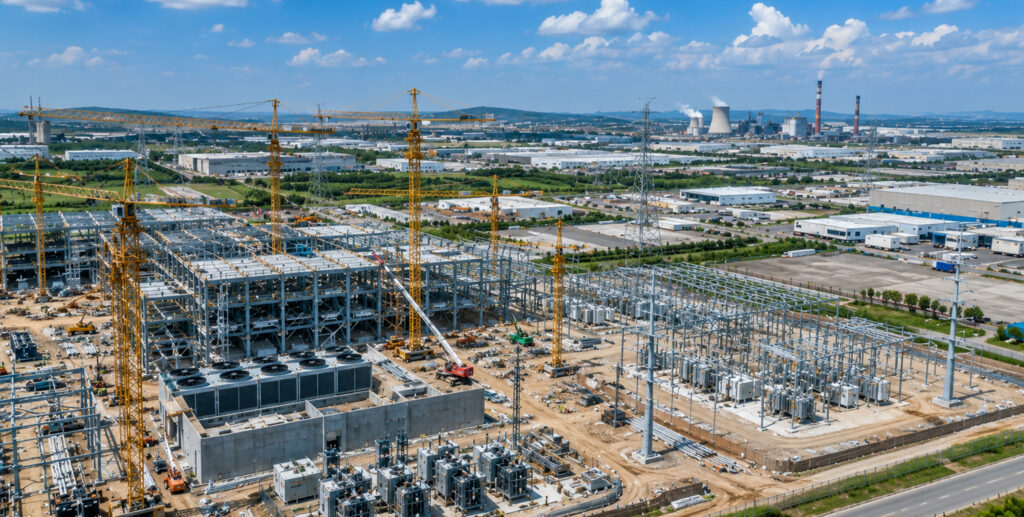
The U.S. is in the middle of a historic data-center construction wave, one of the largest ever recorded, driven by explosive demand for AI compute, cloud storage, and high-density digital infrastructure.
Manufacturers and developers are racing to build:
- AI-optimized server farms
- High-density compute clusters
- Liquid-cooling and immersion-cooling facilities
- Power-intensive hyperscale campuses
- Electrical and grid-upgrade infrastructure
Manufacturers from global giants like ABB and Siemens to small family-owned firms are aggressively investing in this vertical because the opportunity is massive and growing.
What’s Driving the Boom?
- AI workloads requiring unprecedented compute power
- Cloud providers expanding storage and processing capacity
- A surge in connected devices across homes and industry
- Enterprise adoption of machine learning and automation
- Long-term commitments from hyperscalers to build new campuses
This boom is reshaping industrial construction, labor demand, and regional economic development.
Why Manufacturing Demand Is Cooling in Semiconductors and Metals
While data centers surge, several manufacturing sectors are slowing, a reversal from the post-pandemic spike.
Semiconductors
After years of shortages, semiconductor inventories have normalized. Many chipmakers are now:
- Working through excess supply
- Delaying new equipment purchases
- Pausing expansion until demand stabilizes
This cooling reflects a return to equilibrium after the extreme volatility of 2021–2023.
Metals & Fabricated Products
Manufacturers are reporting:
- Softer order volumes
- Lower pricing pressure
- Reduced demand from construction and durable goods
- A shift from expansion to maintenance spending
Industrial Machinery & Equipment
OEMs are seeing:
- Longer sales cycles
- Deferred capital investments
- Fewer large-scale equipment orders
These trends reflect cautious spending amid mixed economic signals.
How AI Is Reshaping Industrial Demand Patterns
The divergence between booming data centers and cooling manufacturing sectors highlights a major structural shift in U.S. industrial demand.
- Capital Is Flowing Toward AI Infrastructure
Companies are prioritizing compute capacity over traditional industrial expansion.
- Power Availability Is Becoming a National Constraint
Data centers require enormous electrical loads, forcing utilities and manufacturers to compete for capacity.
- Supply Chains Are Normalizing After Pandemic Distortions
Sectors that overheated during shortages are now stabilizing.
- AI Infrastructure Is Creating New Industrial Winners
Electrical equipment, transformers, switchgear, cooling systems, and power-distribution manufacturers are seeing strong growth.
- Regional Economies Are Being Redrawn
States with available power including Ohio, Texas, Georgia, and Arizona, are becoming AI-infrastructure hubs.
What This Means for U.S. Manufacturers
Short-Term Outlook
- Expect softer demand in semiconductors, metals, and industrial equipment.
- Prepare for longer sales cycles and more cautious capital spending.
- Watch for AI-related opportunities in electrical and cooling systems.
Long-Term Outlook
- AI infrastructure will drive multi-year demand for power equipment, construction materials, and advanced manufacturing.
- Semiconductor demand will rebound as new fabs come online and AI hardware evolves.
- Metals and industrial equipment will stabilize as reshoring and infrastructure spending continue.
Strategic Implications
Manufacturers should align with the AI-infrastructure boom by focusing on:
- Power systems
- Cooling technologies
- High-density materials
- Electrical components
- Automation and robotics
Companies that pivot early will capture the next wave of industrial growth.
Key Takeaways
- U.S. data center construction is booming due to AI and cloud demand.
- Manufacturing demand is cooling in semiconductors, metals, and industrial equipment.
- AI infrastructure is reshaping capital spending and supply-chain priorities.
- Power availability is emerging as a major national constraint.
- Long-term opportunities remain strong for manufacturers aligned with AI-driven growth.
FAQ
Why is data center construction growing so quickly?
AI workloads, cloud expansion, and high-density compute demand are driving unprecedented investment in new facilities.
Why is semiconductor demand cooling?
Inventories have normalized after years of shortages, leading to slower equipment purchases.
Which manufacturing sectors are slowing?
Semiconductors, metals, fabricated products, and industrial machinery.
Will manufacturing rebound?
Yes, long-term demand remains strong due to reshoring, infrastructure spending, and the next wave of AI hardware.
 Spotify
 Apple Podcasts
 Podbean
 YouTube
 Spotify
 Apple Podcasts
 Podbean
 YouTube