Artificial intelligence is rapidly becoming one of the most important technologies shaping the future of manufacturing. What was once considered an experimental tool is now being deployed across factories, supply chains, and engineering departments to improve efficiency, reduce costs, and enhance decision making.
Manufacturers have always relied on data to guide operations, but the amount of data generated in modern factories is staggering. Industrial machines, robotics systems, sensors, and production lines generate enormous streams of operational data every second. Artificial intelligence provides the analytical power needed to turn that data into useful insights.
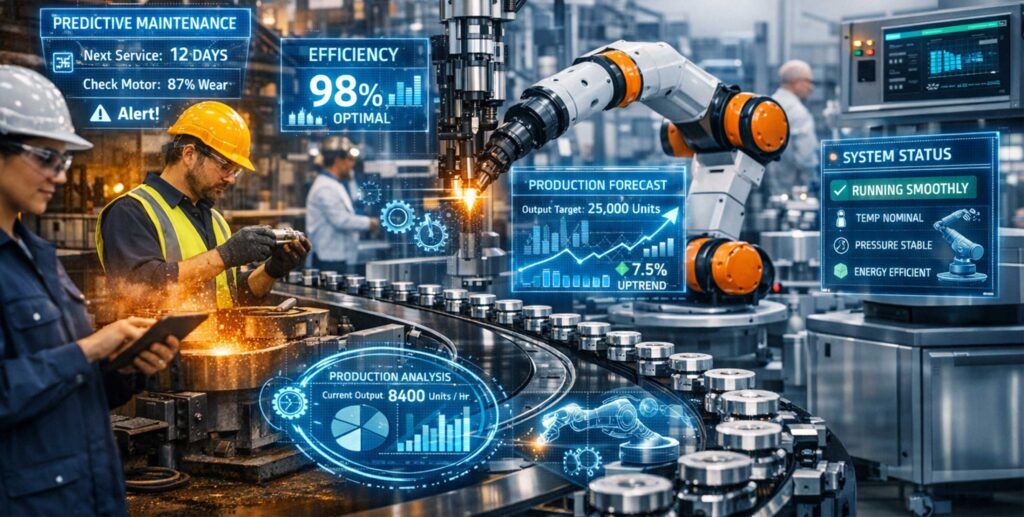
One of the most significant applications of AI in manufacturing is predictive maintenance. Traditionally, manufacturers performed maintenance based on fixed schedules or after equipment failures occurred. Both approaches are inefficient. Scheduled maintenance can waste time and resources, while unexpected breakdowns can halt production entirely.
AI powered predictive maintenance systems analyze sensor data such as vibration patterns, temperature changes, and equipment performance metrics. By identifying subtle anomalies, these systems can detect potential equipment failures before they occur.
Studies show predictive maintenance systems can reduce equipment downtime by as much as 50 percent while lowering maintenance costs by 10 to 40 percent. For manufacturers operating expensive machinery or high volume production lines, those improvements can translate into millions of dollars in savings each year.
Another area where AI is making a significant impact is quality control. Computer vision systems powered by machine learning algorithms can inspect products at extremely high speeds while identifying defects that may be invisible to the human eye.
In industries such as electronics manufacturing or aerospace component production, where precision is critical, these AI inspection systems dramatically reduce defect rates and improve overall product quality.
AI is also transforming production planning. Manufacturing schedules must constantly adapt to changes in customer demand, supply chain disruptions, and machine availability. AI systems can analyze thousands of variables simultaneously to generate optimized production schedules in real time.
This capability is particularly valuable in complex manufacturing environments where multiple production lines, suppliers, and product configurations must be coordinated simultaneously.
According to recent industry surveys, approximately 60 percent of manufacturers report measurable cost reductions after implementing AI driven automation technologies. These savings come from improved production efficiency, reduced waste, and more accurate forecasting.
AI is also reshaping supply chain management. Predictive analytics systems analyze market demand patterns, shipping data, and supplier performance metrics to forecast potential disruptions and adjust logistics strategies accordingly.
For example, AI models can analyze weather patterns, geopolitical risks, and port congestion data to anticipate shipping delays and recommend alternative supply routes.
Despite its benefits, AI adoption in manufacturing still faces several challenges. Many factories operate legacy equipment that was not originally designed to collect or transmit digital data. Integrating AI systems into these environments requires significant infrastructure upgrades and careful planning.
Workforce skills are another challenge. As factories become more data driven, manufacturers need employees with expertise in data science, machine learning, and industrial analytics.
However, the potential benefits of AI adoption are simply too significant to ignore. Industry analysts estimate that AI technologies could contribute more than $15 trillion to the global economy by 2030, with manufacturing expected to capture a significant portion of that value.
For manufacturers, artificial intelligence represents more than just another technology upgrade. It represents a fundamental shift in how factories operate. Instead of reacting to problems after they occur, AI allows manufacturers to anticipate challenges, optimize operations, and make smarter decisions before disruptions ever happen.
 Spotify
 Apple Podcasts
 Podbean
 YouTube
 Spotify
 Apple Podcasts
 Podbean
 YouTube