Summary
Most U.S. metalforming manufacturers expect stable economic activity in the coming months, according to the Precision Metalforming Association’s latest Business Conditions Report. While orders and shipments remain steady, companies continue to face labor shortages, cost pressures, and uncertainty around tariffs and supply-chain reliability.
Why Metalforming Manufacturers Expect Steady Conditions
The PMA report shows that metalforming companies anticipate no major swings in business activity. Stability, not expansion or contraction, is the dominant outlook.
Manufacturers cite consistent customer demand across automotive, industrial, appliance, and aerospace markets. While not booming, these sectors are maintaining predictable order volumes, giving shops confidence that near-term conditions will remain level.
This stability follows several months of gradual improvement after a period of volatility in 2024–2025.
Orders and Shipments Hold Steady Across the Sector
Metalforming companies report:
- Stable incoming orders
- Consistent shipment levels
- Predictable production schedules
- No significant backlog increases or declines
This suggests that customers maintain regular purchasing patterns rather than pulling back or accelerating orders.
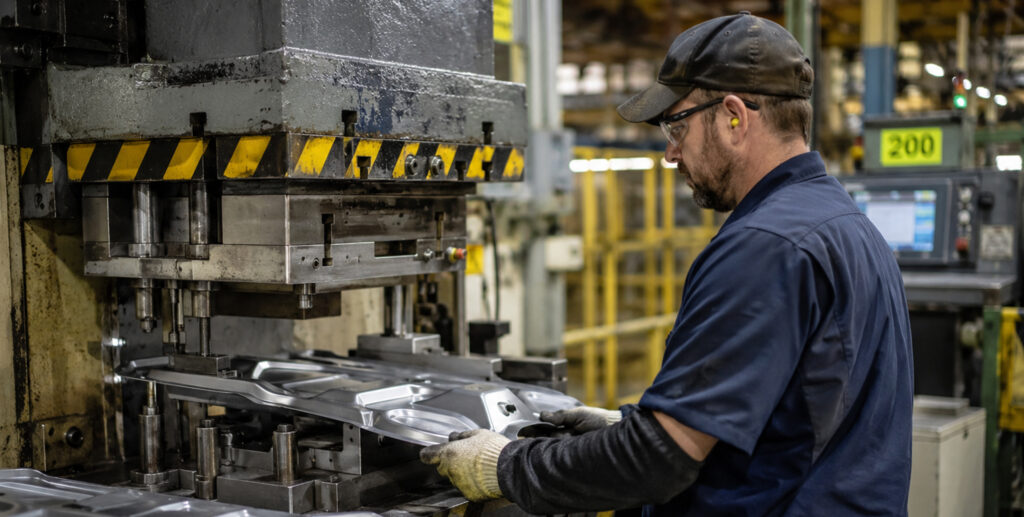
Automotive suppliers, a major segment of the metalforming industry, continue to drive steady demand for stamped parts, assemblies, and tooling.
Labor Shortages and Hiring Challenges Persist
Despite stable demand, manufacturers continue to struggle with:
- Difficulty finding skilled press operators and toolmakers
- Competition for entry-level production workers
- Higher labor costs
- Training and retention challenges
PMA notes that workforce constraints remain one of the biggest barriers to growth, even as economic conditions stabilize.
Tariffs, Materials Pricing, and Supply-Chain Uncertainty Remain Concerns
Metalforming companies are looking at several external factors closely:
- Tariff policy changes affecting steel and aluminum
- Volatile materials pricing
- Lead-time unpredictability for specialty metals
- Geopolitical disruptions impacting global sourcing
These issues create planning challenges, even when demand is steady.
What Stable Conditions Mean for the Metalforming Industry
- Predictable Production Planning
Shops can maintain consistent schedules and staffing levels.
- Continued Investment in Efficiency
Manufacturers are focusing on automation, tooling upgrades, and process improvements rather than major expansions.
- Stronger Customer Relationships
Stable demand allows suppliers to strengthen long-term partnerships with OEMs.
- Ongoing Workforce Development Needs
Labor shortages remain a structural challenge that stability alone cannot solve.
- Watchful Approach to Tariffs and Materials Costs
Manufacturers remain cautious as policy and pricing shifts could quickly change conditions.
Key Takeaways
- Most metalforming manufacturers expect stable economic activity in the near term.
- Orders and shipments remain consistent across major customer sectors.
- Labor shortages continue to challenge production capacity.
- Tariffs, materials pricing, and supply-chain uncertainty remain key risks.
- Stability allows manufacturers to focus on efficiency and workforce development.
FAQ
What does the PMA report say about economic activity?
Most metalforming manufacturers expect stable conditions with no major changes in demand.
Are orders increasing or decreasing?
Orders and shipments are holding steady across the sector.
What challenges do manufacturers still face?
Labor shortages, materials pricing volatility, and tariff uncertainty.
Is the outlook positive or cautious?
Cautiously stable; manufacturers expect consistency but remain alert to external risks.
 Spotify
 Apple Podcasts
 Podbean
 YouTube
 Spotify
 Apple Podcasts
 Podbean
 YouTube