
Summary
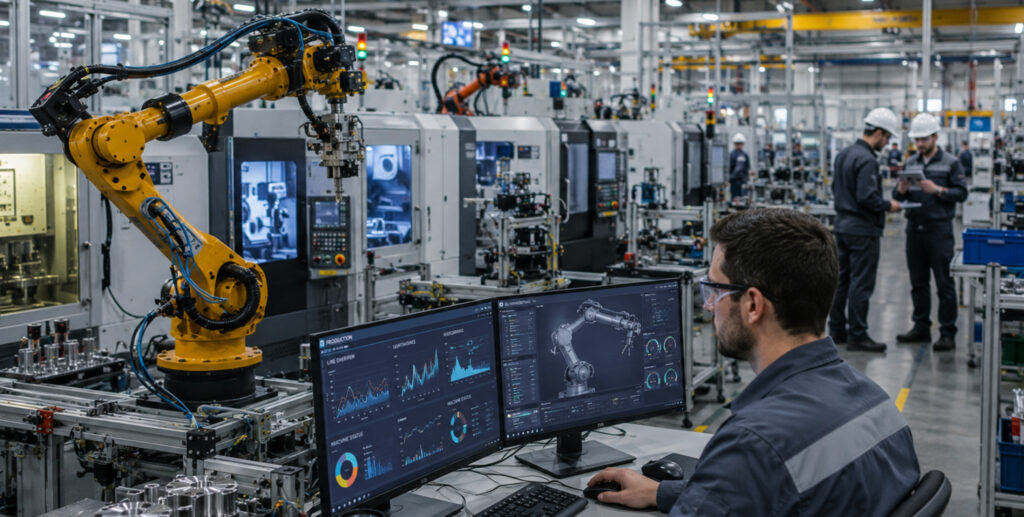
AI and data-driven technologies are reshaping U.S. manufacturing by improving productivity, reducing downtime, enhancing quality, and enabling predictive decision-making. Manufacturers adopting AI-powered automation, analytics, and connected-factory systems are seeing faster throughput, fewer defects, and stronger operational resilience, positioning them for long-term competitiveness.
Why AI Is Becoming Essential for Modern Manufacturing
Manufacturers face rising pressure from labor shortages, supply-chain volatility, cost increases, and customer expectations for faster delivery. CLA notes that AI offers a scalable way to address these challenges by automating repetitive tasks, analyzing complex data, and enabling real-time decision support.
AI is no longer experimental; it is becoming a core operational tool across machining, assembly, quality control, logistics, and maintenance.
How Data-Driven Manufacturing Improves Productivity and Efficiency
Data is the backbone of AI-enabled manufacturing. When factories collect and analyze machine, sensor, and process data, they can:
- Identify bottlenecks
- Optimize production schedules
- Reduce scrap and rework
- Improve cycle-time consistency
- Increase overall equipment effectiveness (OEE)
Manufacturers using connected-factory systems gain visibility across operations, allowing them to make faster, more accurate decisions.
Predictive Maintenance Reduces Downtime and Extends Equipment Life
AI-powered predictive maintenance is one of the most impactful applications. Instead of relying on fixed schedules or reacting to breakdowns, manufacturers can use
machine-learning models to detect early signs of failure.
Benefits include:
- Fewer unplanned outages
- Longer equipment lifespan
- Lower maintenance costs
- Better spare-parts planning
- Higher uptime and throughput
Predictive maintenance is especially valuable for CNC machines, robotics, conveyors, and high-precision equipment.
AI-Enhanced Quality Control Improves Accuracy and Reduces Defects
AI vision systems and machine-learning inspection tools can detect defects more accurately than manual inspection. These systems:
- Identify micro-defects invisible to the human eye
- Reduce false positives
- Improve consistency across shifts
- Provide real-time feedback to operators
Manufacturers using AI-driven quality systems report higher first-pass yield and lower scrap rates.
Automation and Robotics Become Smarter with AI Integration
AI enhances robotics by enabling:
- Adaptive motion control
- Real-time path optimization
- Automated part recognition
- Dynamic response to variability
This allows robots to handle more complex tasks, reducing labor pressure and improving safety. AI-enabled automation is especially valuable in machining, packaging, assembly, and materials handling.
How Manufacturers Can Begin Their AI Transformation
- Start with High-Value Use Cases
Predictive maintenance, quality inspection, and scheduling optimization deliver fast ROI.
- Build a Strong Data Foundation
Clean, structured data is essential for effective AI deployment.
- Integrate Systems Across the Factory
Connected machines and unified data platforms improve visibility and decision-making.
- Train and Upskill Workers
Operators, technicians, and engineers need digital skills to manage AI-enabled workflows.
- Partner with Experts
Consultants and integrators help manufacturers deploy AI safely, efficiently, and strategically.
Key Takeaways
- AI and data-driven solutions are transforming productivity, quality, and maintenance.
- Predictive maintenance reduces downtime and extends equipment life.
- AI-powered quality systems improve accuracy and reduce defects.
- Smarter automation helps manufacturers overcome labor shortages.
- A strong data foundation is essential for successful AI adoption.
FAQ
Why is AI important for manufacturing?
It improves productivity, reduces downtime, enhances quality, and supports better
decision-making.
Where does AI deliver the fastest ROI?
Predictive maintenance, quality inspection, scheduling optimization, and connected-factory analytics.
Do manufacturers need large datasets to use AI?
Not always; many AI tools work with existing machine and sensor data.
How does AI affect the workforce?
It augments workers by automating repetitive tasks and enabling higher-skill roles.
 Spotify
 Apple Podcasts
 Podbean
 YouTube
 Spotify
 Apple Podcasts
 Podbean
 YouTube