Summary
Hybrid machining, the combination of additive manufacturing and subtractive CNC machining in a single platform, is gaining momentum as shops seek faster production, tighter tolerances, and greater design flexibility. Adoption is rising across aerospace, medical, mold-making, and high-value industrial sectors, creating new opportunities for manufacturers to expand their capabilities and win more complex work.
Why Hybrid Machining Is Becoming a Strategic Advantage
Manufacturers are increasingly turning to hybrid machining because it solves long-standing production challenges. Traditional machining is precise but limited when producing complex geometries. Additive manufacturing enables those geometries but often lacks the surface finish and tolerances required for final parts.
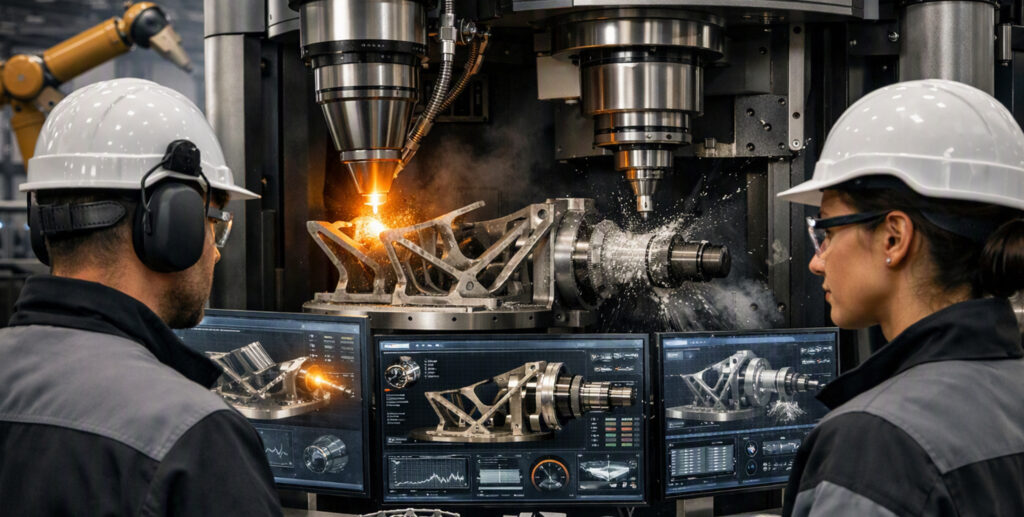
Hybrid systems merge both processes, allowing shops to build near-net-shape components additively and finish them immediately with CNC machining, all in one setup. This reduces lead times, eliminates multiple machine transfers, improves accuracy, and expands the types of parts shops can produce.
As industries demand lighter, stronger, more complex components, hybrid machining is becoming a competitive differentiator rather than a niche capability.
How Hybrid Machining Expands Shop Capabilities
Hybrid platforms allow shops to take on work that previously required multiple vendors or specialized equipment. Manufacturers can repair worn components, add features to existing parts, or produce intricate internal structures that traditional machining cannot reach.
Shops can also consolidate workflows. Instead of printing a part, transferring it to a CNC machine, and re-fixturing it, all steps that introduce error in hybrid systems maintain perfect alignment throughout the process. This improves part quality and reduces scrap.
For job shops, mold makers, aerospace suppliers, and medical manufacturers, hybrid machining opens the door to new revenue streams and more profitable, high-value work.
Industries Leading the Adoption of Hybrid Machining
Aerospace & Defense
Hybrid machining supports lightweight structures, complex geometries, and rapid repair of high-value components, all critical for aircraft and defense systems.
Medical Devices
Implants, surgical tools, and custom components benefit from hybrid machining’s precision and ability to produce organic shapes with tight tolerances.
Moldmaking & Tooling
Hybrid systems allow shops to repair molds, add features, and produce conformal cooling channels that improve cycle times and part quality.
Energy & Industrial Equipment
Turbine components, pump housings, and high-wear parts can be repaired or enhanced with additive material and finished in the same machine.
What Hybrid Machining Means for the Future of Manufacturing
- Faster Production Cycles
Hybrid machining reduces setup time, eliminates transfers, and accelerates part completion.
- More Complex, High-Value Parts
Shops can produce geometries that were previously impossible or cost-prohibitive.
- Lower Scrap and Higher Accuracy
Maintaining alignment throughout additive and subtractive processes improves precision.
- New Revenue Opportunities
Repair work, custom tooling, and advanced component production expand shop offerings.
- A Pathway to Full Digital Manufacturing
Hybrid systems integrate naturally with CAD/CAM, simulation, and digital-twin workflows.
Key Takeaways
- Hybrid machining combines additive manufacturing and CNC machining in one platform.
- Adoption is rising across aerospace, medical, mold making, and industrial sectors.
- Shops gain faster production, tighter tolerances, and expanded capabilities.
- Hybrid systems reduce scrap, improve accuracy, and eliminate multi-machine transfers.
- Technology creates new revenue opportunities and supports advanced manufacturing strategies.
FAQ
What is hybrid machining?
A manufacturing process that integrates additive manufacturing and CNC machining in a single machine.
Why is hybrid machining growing?
It enables faster production, more complex geometries, and higher precision than additive or machining alone.
Which industries benefit most?
Aerospace, medical, mold making, energy, and high-value industrial manufacturing.
How does hybrid machining improve part quality?
It maintains perfect alignment between additive and subtractive processes, reducing error and improving tolerance.
 Spotify
 Apple Podcasts
 Podbean
 YouTube