Summary
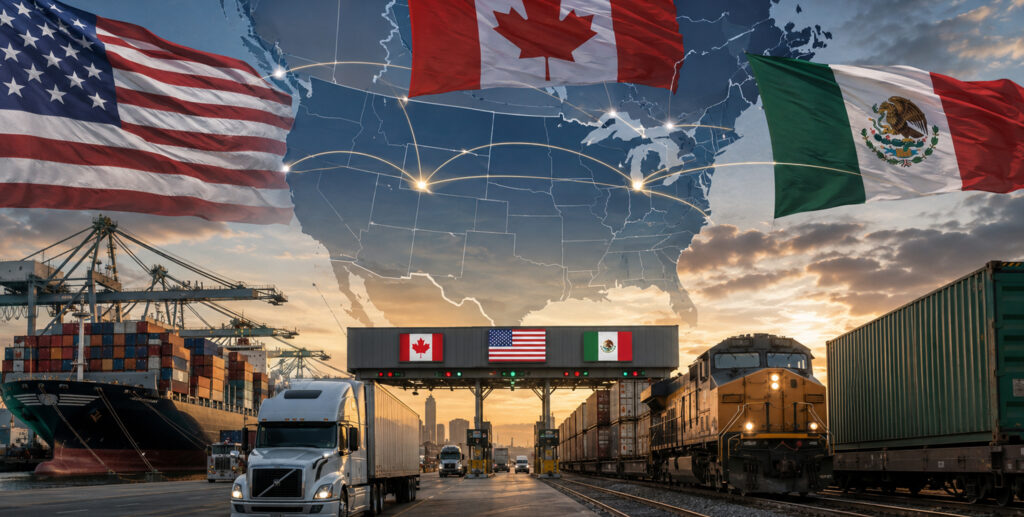
The United States, Canada, and Mexico have begun the renewal process for the U.S.–Mexico–Canada Agreement (USMCA), launching negotiations that are expected to be lengthy and contentious. The U.S. is pushing for major changes, including stricter automotive content rules and a new requirement that 50% of vehicles be made in the United States, while Canada and Mexico warn these demands threaten regional integration, supply chains, and consumer prices.
Why USMCA Renewal Is So High-Stakes
North American trade is enormous, $1.9 trillion a year, or $5 billion every day, and Canada and Mexico have overtaken China as America’s top trading partners. Any disruption to the pact affects:
- Automotive production
- Agriculture
- Consumer goods
- Cross-border supply chains
- Prices for U.S. consumers
After a year of volatile tariff actions, businesses want stability. Instead, they’re getting uncertainty.
What Triggered the Renewal Process
The USMCA includes a unique provision requiring the pact to be reviewed and renewed every six years. That deadline arrived this week.
The three countries met virtually, but the U.S. Trade Representative said the United States is not ready to renew the pact for another 16 years (through 2042) without significant changes.
The agreement remains in effect until 2036, but if no deal is reached by then, it expires.
The U.S. Position: More Production Must Move to America
The United States is pushing for sweeping changes that would shift manufacturing, especially automotive, into U.S. factories.
- Raising the Automotive Content Requirement
USMCA currently requires 75% of a vehicle to be made in North America to qualify for
duty-free treatment. The U.S. wants to push this number even higher.
Automakers warn that this is extremely difficult because supply chains have already been optimized to hit the 75% threshold.
- A New Rule: 50% of Cars Must Be Made in the U.S.
Canadian Prime Minister Mark Carney confirmed the U.S. is demanding a brand-new requirement: 50% of all vehicles must be produced in the United States.
This is a red line for both Canada and Mexico.
Only 1 in 5 Mexican and Canadian vehicles imported into the U.S. would meet this standard today.
- Preventing Chinese Goods From Entering Through Mexico or Canada
The U.S. wants tighter rules of origin to stop Chinese components from entering the region duty-free.
Canada’s Position: “We’re Not Looking for Our Pen”
Canada has not yet been fully included in U.S.–Mexico discussions, raising fears it could be presented with a “take it or leave it” deal.
Carney emphasized:
- Canada will not rubber-stamp changes
- Congress must approve any new agreement
- Canada wants modernization, not unilateral concessions
Canada is particularly concerned about losing automotive production and facing higher consumer prices.
Mexico’s Position: Cautious but Optimistic
Mexican Economy Secretary Marcelo Ebrard said Mexico believes the review can be completed “within a reasonable time frame,” but wants to avoid prolonged uncertainty.
Mexico opposes:
- The 50% U.S. production requirement
- Any rules that undermine regional integration
- Sudden changes that disrupt supply chains
Mexico fears the U.S. could withdraw from the pact with six months’ notice, a real possibility given recent statement.
How These Negotiations Could Affect Consumers and Manufacturers
Higher Vehicle Prices
Economist Marcos Carias estimates affected models could see 5%–7% price increases, including:
- Ford Maverick
- Chevrolet Equinox
- Nissan sedans
Supply Chain Disruption
Automakers have spent years fine-tuning supply chains to meet USMCA rules. New requirements would force costly restructuring.
Small Businesses at Risk
Companies relying on imported components like silicone grips or specialty materials fear stricter rules will make compliance impossible.
Tariff Volatility
Businesses cite unpredictable tariff swings as a major challenge. Many simply want stable, predictable rules.
Why Businesses Want Stability, Not More Drama
Companies across North America say the biggest problem is uncertainty.
Examples from the article:
- PKGD Group paid $105,000 in unexpected tariffs on Mexican spirits due to sudden rule changes.
- Small manufacturers say USMCA rules are too complex to navigate without lawyers.
- Importers fear new tariffs could appear overnight.
As one business owner put it: “We’d really like to know what the rules are and we’d like them to stay that way for a while.”
Key Takeaways
- USMCA renewal has begun, and negotiations are expected to be contentious.
- The U.S. is demanding stricter automotive rules and a new requirement that 50% of vehicles be made in the U.S.
- Canada and Mexico say these demands violate the spirit of regional integration.
- Businesses fear higher prices, disrupted supply chains, and tariff unpredictability.
- The pact remains in effect until 2036, but uncertainty is already affecting companies.
FAQ
Why is the U.S. pushing for changes?
To reduce trade deficits, tighten rules of origin, and shift more production into U.S. factories.
What is Canada’s biggest concern?
Being sidelined while the U.S. and Mexico negotiate changes that Canada is later forced to accept.
What is Mexico’s biggest concern?
Sudden rule changes that disrupt supply chains and the possibility of a U.S. withdrawal.
Will vehicle prices increase?
Likely economists estimate 5%–7% increases for models heavily produced in Mexico.
Is the agreement at risk of collapsing?
It remains in effect until 2036, but any country can withdraw with six months’ notice.
 Spotify
 Apple Podcasts
 Podbean
 YouTube