
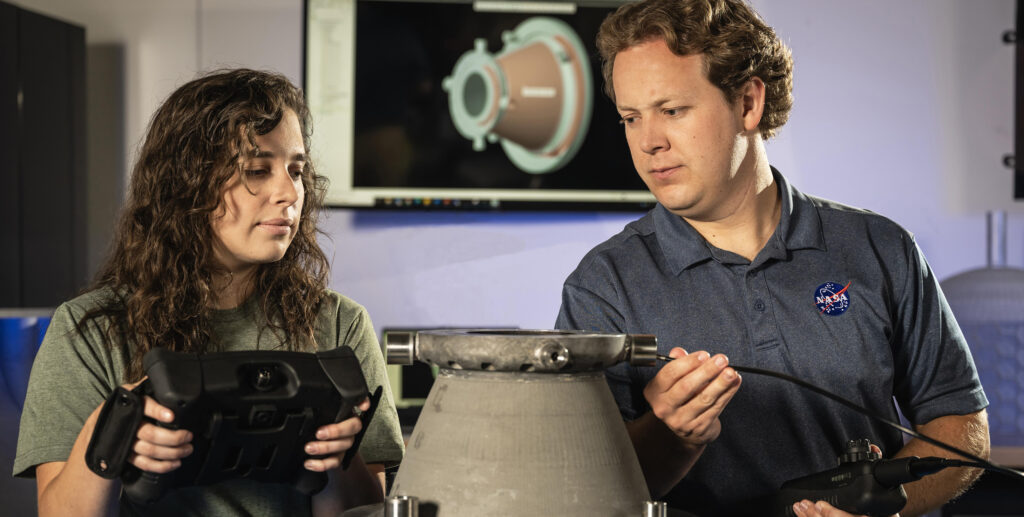
3D printing isn’t just reshaping factories on Earth; it’s reshaping the future of space exploration. What once sounded like science fiction is now standard practice across NASA, commercial launch companies, and aerospace suppliers. And as Advanced Manufacturing reports, additive manufacturing has officially reached the stars, powering rockets, satellites, and deep-space missions with parts that simply couldn’t exist using traditional methods.
The shift has been dramatic. NASA now uses more than 6,000 additively manufactured parts across its programs, and companies like SpaceX, Relativity Space, Blue Origin, and Rocket Lab have embraced 3D printing as a core part of their engineering strategy. Relativity famously attempted to build a rocket that was 85% 3D-printed by mass, while Rocket Lab’s Rutherford engine uses 3D-printed combustion chambers and pumps that allow for rapid iteration and lighter, more efficient designs.
Why the surge? Because additive manufacturing solves problems that aerospace engineers have wrestled with for decades. Traditional machining often requires multiple components, welds, and assembly steps. 3D printing collapses those into a single, optimized structure. NASA’s propulsion teams have said that some of their new engine components would require “hundreds of parts if machined traditionally, but can be printed as one.” That means fewer failure points, lower weight, and faster production.
The numbers tell the story. According to the Aerospace Industries Association, additive manufacturing can reduce part lead times by 70–90% and cut costs by 50% or more for complex geometries. In an industry where delays can cost millions per day, that’s a game-changer. As one NASA engineer put it, “Additive manufacturing lets us design for performance, not for manufacturability.”
And the technology isn’t just helping rockets lift off, it’s helping them survive the journey. 3D-printed heat exchangers, fuel injectors, and structural brackets are now being tested for missions to the Moon and Mars. The European Space Agency recently demonstrated a 3D-printed lunar regolith brick strong enough to support infrastructure, hinting at a future where astronauts might print habitats directly on the Moon’s surface. Meanwhile, the International Space Station has been using a 3D printer since 2014, allowing astronauts to manufacture tools and replacement parts on demand rather than waiting months for resupply.
Commercial space companies are pushing the envelope even further. SpaceX uses additive manufacturing for SuperDraco engines, grid fin components, and internal structures across Starship. Blue Origin prints key parts of its BE-4 engine, which powers both New Glenn and ULA’s Vulcan rocket. And Relativity Space’s massive Stargate printers, some of the largest metal 3D printers in the world, are designed to produce entire rocket stages in a matter of weeks.
The momentum is only accelerating. The global market for additive manufacturing in aerospace is expected to surpass $7.8 billion by 2030, according to SmarTech Analysis, driven by demand for lighter components, faster production cycles, and more resilient supply chains. With geopolitical tensions and launch demand rising, aerospace companies are turning to 3D printing not just for innovation, but for survival.
What’s striking is how seamless additive manufacturing has moved from experimental to essential. A decade ago, 3D-printed rocket parts were a curiosity. Today, they’re flying regularly and performing flawlessly. As one industry leader told Advanced Manufacturing, “We’re not testing the future anymore. We’re using it.”
And that’s the real story: 3D printing isn’t just reaching stars, it’s helping humanity reach them faster, safer, and with more imagination than ever before.
 Spotify
 Apple Podcasts
 Podbean
 YouTube
 Spotify
 Apple Podcasts
 Podbean
 YouTube