TRANSCRIPT
Speaker 1 (00:00):
Welcome to Manufacturing Talk Radio, your Everything manufacturing podcast with host and veteran manufacturing industry expert Lewis Weiss and co-host Amy Nicklaus. Make sure to check out our catalog of 800 previous shows on YouTube, Spotify, or wherever you’re listening. Now, let’s get into the episode.
Speaker 2 (00:24):
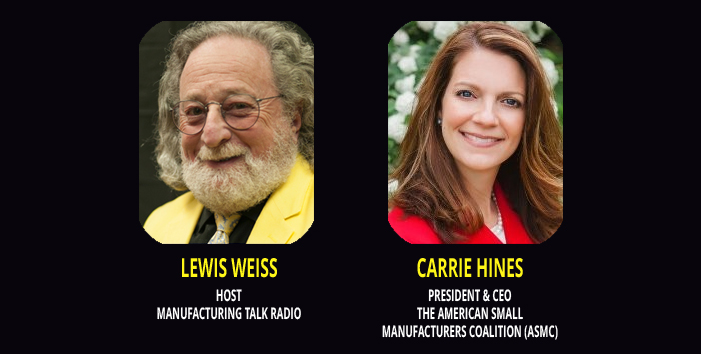
Welcome everyone. Lew Weiss Manufacturing Talk Radio. I’m glad to have everybody here again today. And we have a special guest, Carrie Hines, who’s the president and CEO of the American Small Manufacturer’s Coalition. And small means, I dunno, 80% of manufacturing in the United States. Is that correct?
Speaker 3 (00:47):
About 99%, actually.
Speaker 2 (00:49):
99%,
Speaker 3 (00:50):
Yes. But again, small is less than 500. So some people think, well, that’s not small, but that’s how it’s defined within SBA.
Speaker 2 (00:59):
So we’re here today to talk about the American Small Business Association Coalition and also the relationship with MEP, the Manufacturing Extension Program and what that’s all about and what sort of crises that they’re going through right now also, but we’ll talk about that. Tell us about American Small Manufacturing.
Speaker 3 (01:28):
Well, first of all, Lew, thank you so much for having me. As you mentioned, I’m president and CEO of the American Small Manufacturers Coalition, which is a coalition of the manufacturing extension partnership centers nationwide. So it’s a little misleading. I actually don’t have small manufacturers as members, but the MEP centers across the country serve more than 35,000 small manufacturers a year. So again, I represent the MEP centers, but by extension the small manufacturers in which they serve.
Speaker 2 (01:58):
Excellent. So give us a two minute explanation for those who are not familiar with the meps.
Speaker 3 (02:06):
So the Manufacturing Extension Partnership Program is a program within the National Institute of Standards and Technology, which is an agency within the Department of Commerce. And what the MEP program does, it’s a public-private partnership. It provides funding to establish offices in all 50 states and Puerto Rico, which are offices that go out and are kind of boots on the ground to help manufacturers in their plant facility. So they actually provide technical assistance and go to manufacturing facilities and provide a host of different services from advanced manufacturing technologies to workforce to cybersecurity, to plant layout, any service, technical service you can imagine. MEP provides.
Speaker 2 (02:46):
Are these fee-based or
Speaker 3 (02:49):
They are. One of the critical parts of the MEP program is, although it’s partially government funded, it’s actually has to be meshed by one-to-one, one federal dollar to one non-federal dollar. And that non-federal dollar can come from a state government, it can come from universities, but more often than not, it comes from the fees that manufacturers pay to get the services. So it is a fee-based service, but that allows MEP centers to reach them all across the country.
Speaker 2 (03:18):
We were very much involved with N-J-M-E-P-A couple of years ago, and they really did amazing work here. And John Kennedy, who, and I know he was the head of the N-J-M-E-P, they did some really fine work. We had some of the MEP people on our show. Tell us about the problem that meps are going through now. I’ll preface it by saying that I am not getting political.
Speaker 3 (03:46):
Meps experienced some problems in the past year, more so than not, but it’s not been unique in its history. So what that stems from is essentially an administration that has proposed to zero out the program in its budget. Now, we’ve seen that in previous administrations, and thankfully Congress bipartisan has been very supportive of this program. So it has been restored every year and has grown over time. The challenges in the past year is not only has it been proposed to be eliminated, but they’ve canceled or failed to renew some centers, which really called on Congress to say, what’s happening there? What’s the idea? And they were really looking to revamp, reevaluate the program at the federal level, and Congress said, no, if you want to do that, you need to do it through the proper processes. So that’s been the challenge over the past year, but thankfully it’s been a difficult year. We’ve seen significant delays in the renewals or repetition of MEP centers, but we are seeming to be back on track now with those centers being renewed in a much more timely fashion and competitions being held.
Speaker 2 (04:49):
Not to be political, but it was Ronald Reagan who instituted the MEP program back in, I think 1988.
Speaker 3 (04:59):
88, correct, yes.
Speaker 2 (05:01):
It’s been around a long time. 37 years, if my math is right, maybe 38.
Speaker 3 (05:07):
38, I think. Yes.
Speaker 2 (05:09):
So tell us a little bit more about the MEPS and what industries they’ve been focusing in on.
Speaker 3 (05:17):
So MEP, the great thing about MEP, it’s not industry specific besides manufacturing. It really spams all different industries and manufacturing. And that really kind of depends on where the MEP centers are located in the country. Clearly, in some areas, they’re going to have a higher density of automobile manufacturers or suppliers and others, food manufacturers. So the great thing is, is we’re not pegged to one industry, and it may be something that’s more prominent in that region. For example, the southeast has a really high density of auto suppliers and manufacturers, but if there’s someone in say, the Northwest or Midwest that needs an auto supplier, that’s the great thing about the MEP National Network is we can reach across state boundaries to get expertise from other MEP centers to help their own clients out.
Speaker 2 (06:03):
So it’s more regional focus as to where certain industries have developed and grown.
Speaker 3 (06:10):
Yeah, I mean, you’ll see the industry clusters in different places in America. So Northwest is predominantly dynamic manufacturers. So you see aerospace out there, so food manufacturers, the Southwest, there’s just a lot more different manufacturers in different areas, mainly because of regional clusters.
Speaker 2 (06:29):
Supply chain has been a big issue over the recent years. How has MEP and A SMC been involved in that?
Speaker 3 (06:40):
It’s been a huge issue, and I think that as a country, we really haven’t seen or understood the supply chain until we all couldn’t get our toilet paper. So the sad thing is out of C, the importance of supply chain really kind of became elevated. MEP has always known that’s been an issue, but it became elevated and thankfully a lot more attention was directed to the importance of the supply chain. So what MEP does is we really focus on those lower tiers, so lower tiers of the supply chain that are really critically important into an OEM, an original equipment manufacturer. So we’ve really got to shore up those very small suppliers in the supply chain because if something should disrupt them, it really will disrupt the entire supply chain. So what MEP has been doing is we’ve really been working with manufacturers, kind mapping out where they are in the supply chain, identifying risks, helping them kind of mitigate those risks so that it protects the entire supply chain. And we’ve also been looking for more domestic resources to provide. So some of the large OEMs have outsourced a lot, and we’re really trying to target and focus them a little bit more domestically.
Speaker 2 (07:48):
To what degree is reassuring an issue within your group? And do you also know Harry Moser by any chance?
Speaker 3 (07:59):
I do. I haven’t spoken to Harry in some time, but I do know him and it is critically important of reassuring. And so we’re really working to try to increase the manufacturing productivity here in the US and bringing some of those suppliers back to the US and reshoring some of the overseas suppliers. What NPS are really good at, because we’re kind of boots on the ground, we can really help identify different suppliers here based in the us. That’s been really important, especially with production lag and changes in products. But our access to manufacturer is really our biggest asset, and so we can help reshore those and find other suppliers here in the us.
Speaker 2 (08:37):
I have a bit of a joke with Harry, this song about everybody loves Harry and he always gets a big laugh out of it, and we get a lot of views when he’s on our show.
Speaker 3 (08:51):
He’s a big draw here.
Speaker 2 (08:53):
Oh, absolutely. Absolutely. He was on a couple of weeks ago. He’s one of our regulars back on some regular basis. So strengthening local economies and workforce, that’s become a significant issue in view of the skill gaps and retirees and so on. So tell us a little bit about that.
Speaker 3 (09:18):
Obviously one of the biggest issues as many baby boomers kind of retire, there’s gaps in manufacturing. It also leaves a lot of opportunities for MEPS to really help manufacturers find talent. So we do that in a multitude of ways. So we work very closely with universities and community colleges to help them produce potential employees with a skillset that manufacturers can employ because we work with them, we know what they need, and we work with those institutes to try to develop programs. We also work within a manufacturing company to upskill the current incumbent workforce, which is important. And we’re even working and doing some apprenticeships across the country too. So working with manufacturers and bringing in apprenticeships to help fill that pipeline. Some of the things we’re doing with baby boomers, there’s going to be a huge knowledge loss in that production line. So one of the really, we’re doing some interesting things across the country, especially using things like AI and trying to take that institutional knowledge and translate it into something that can be applied to kind of the next generation and gamification and really kind of using those, translating their knowledge and everyday work and videos and standard operating procedures to help that knowledge continue to that next generation workforce.
Speaker 2 (10:32):
Just a point of information this week is apprenticeship week. The entire week. A couple of years ago, we invited a class from one of the local high schools to join us. We took a busload of high school students and we took them to manufacturing day at New Jersey, MEP, which John Kennedy helped support us in that endeavor. And it’s really amazing when you introduce manufacturing to students, it’s almost like an awakening. And we’ve had meetings with parents about let’s not press the college button so quickly because you wind up with a hundred, $200,000 debt, you can come out earning 40, $50,000 a year when in fact you can take up an apprentice program, have a great life, great career, and you can be in four or five years, you’ll be making a hundred thousand a year. So these are all things that we don’t hear in the straight regular news media. You only hear about that on manufacturing talk radio.
Speaker 3 (11:48):
Well, and that’s a great source for that information. I think that’s what people don’t know. I mean, the average manufacturing salary is over $90,000. And so we’re really working hard collectively in this manufacturing ecosystem to change the perception that it’s dark, dirty and dangerous, and it’s actually high tech and there is a path for growth and to management and to really high tech advanced jobs. But that takes all of us to try to change that perception so that we can really fill that pipeline. But we’ve had some incredible programs across the country, like you mentioned, the one taking manufacturers out of manufacturing day. We’ve also got what’s so cool about manufacturing kind of programs across the country to really inspire that next generation. We even have some kind of manufacturing facilities and partial manufacturing facilities. In the basement of high school is where the high school students will go down and really learn the processes from marketing to production, and it’s opened their eyes to where they want to go next. So we’re working hard, but there’s still a lot of work to do.
Speaker 2 (12:49):
We’re talking with one of the local community colleges here in New Jersey who created a manufacturing facility on their campus, and the kids get points for credits for those classes. And actually, there’s one university in Wisconsin where they run a manufacturing business for the students where the students actually earn during the course of the year, they’ll earn two $3,000. The school makes a little bit of money on the side, and it’s introducing the kids under a right environment to really think about manufacturing as a career path and a career journey. And I think it’s great. Five years ago, six years ago, this wasn’t as big of a success story. Manufacturing talk radio has been doing this now 12 years, and way back then it wasn’t talked about at all. So now it’s a whole new thing and it’s working quite successfully.
Speaker 3 (13:56):
We’re in a much better place today than we were a decade ago. And I think with just the understanding of what manufacturing is and the technology. So I definitely think there’s a better appeal today than there was several years ago. But again, I think this is a continuum we’re going to have to continue to develop and change that culture.
Speaker 2 (14:15):
So for the sake of our audience, how does one get in touch with American Small business?
Speaker 3 (14:22):
One thing you can do is you can go on our website, which is small manufacturers.org. From there you can see MEP centers across the country. They’ll put you in touch with the local MEP center. So if you’re a manufacturer and you’re looking for help, you can get all of our contact information there. It’s small manufacturers.org. You can reach out to me, my information’s on the website as well, and I can put you in touch with the local MEP center for help.
Speaker 2 (14:45):
Do you have an email address that you care to
Speaker 3 (14:48):
Share? I do. It’s carrie.Hines@smallmanufacturers.org. We don’t like anything short here.
Speaker 2 (14:55):
And how does that work? So they reach out to you? What’s the next step? I mean, is this a complicated governmental process?
Speaker 3 (15:03):
It’s not at all. It usually starts with kind of an assessment of what are your needs, what is your immediate need? And then if you’re willing, we take a look at your business and say, okay, here’s where we are. We think some opportunities for improvement, and we can help you through that process. So it works with a contract like any other service, we don’t go in there. We have a contract of what we plan to deliver or provide through a third party, how much it costs. And also usually included is the expected impact of that service. So it’s not a complicated process at all.
Speaker 2 (15:35):
I’ve been in manufacturing half a century, and one of the things that I’ve learned over the years is that manufacturers, they really know what they’re doing. They know how to make things, they know how to sell things and so on. But particularly in today’s world, there’s a lot of things they don’t know. They don’t know a lot about technology. They don’t know a lot about marketing. They don’t know a lot about, I mean, in my day when I first started marketing was the Yellow Pages. The yellow Pages is gone, and marketing is still extremely important. So it’s important that manufacturers recognize what they don’t know and that you can go out and hire yourself a consultant. But I’m sure the consultants costs and prices are much greater than what you folks are charging.
Speaker 3 (16:29):
You said a bunch of things there that are so important. I think they don’t know what they don’t know. So the great thing about MEP is we stay up on the most recent, I say trends in advanced manufacturing technology, even in some cases centers across the country. They have labs within their offices. You can come and see robots cobots, see how they could possibly work for you. So you don’t actually have to implement it and take that risk. You can come see for yourself, learn about it, see if it will apply. That’s very interesting. They stay up on all of that information, and if they don’t have the resources themselves, they are able to connect to trusted folks to provide it. So that’s really important too. So again, MEP centers don’t necessarily deliver a hundred percent of all services. They connect with local providers that they know have vetted in trust.
(17:17):
To your second point about the cost is the cost is really market rate for what those services are. What it does, the MEP, the federal dollar if you will, allows us to reach that clientele. The small manufacturer, because they’re busy, they wear multiple hats, they do lots of things. So they’re not necessarily in all the circles or know all the things. And some of them are very rural, so they’re way out in the state. And so the MEP, the federal funding allows us to reach those small manufacturers that wouldn’t necessarily have the same profit margin that a large consulting firm would be able to provide. So we are able to provide that to them at a reasonable cost that’s of interest to them. So your bigger larger assistance firms out there, it’s just not of interest of them because these projects are very customized to the manufacturer themselves.
Speaker 2 (18:11):
I realize that what I’m going to ask you is dependent upon a lot of the things, but these programs that you create for manufacturing companies, can they be long-term agents?
Speaker 3 (18:24):
Yes. Usually that’s how it works. It’s typical that we’ll have a manufacturer call a local center or hear about something and they’re like, I have this problem. And it’s really a point solution. But when we prove ourselves with that service and they say, oh, they actually do know what they’re doing and they did provide value, then we enter into a larger conversation about the rest of their business. How can better technology, more advanced technology, help them in different ways? What other areas can we help them improve? And so that really point solution opens the door to a broader discussion about how we can improve that manufacturer in different areas. And that does open itself to a longer term engagement with a client.
Speaker 2 (19:06):
I think that’s very important. Once you get involved in a campaign or a program, you don’t want it to end abruptly and then all of a sudden you’re just
Speaker 3 (19:16):
Now
Speaker 2 (19:16):
What?
Speaker 3 (19:17):
Right. It’s a relationship. It really is. And the other thing that’s important is we’re not out there pushing a service, right? I’m not going to go to you and say, you have to do this. We really meet them where they are. So again, AI is a big thing right now, right? You’re hearing a lot of AI push. A lot of manufacturers don’t know what that is. They’re afraid of it. They don’t know how it can apply to them. So we don’t go out and say, you have to implement an AI into your facility. We say, here, we’ll show you what it is. It may make sense for you, it may not. But really, that’s not what we are about pushing solutions. It’s really what they need and meeting them where they are.
Speaker 2 (19:52):
Government making a profit,
Speaker 3 (19:55):
Heaven forbid. No,
Speaker 2 (19:57):
How absurd. Carrie, any parting words for us?
Speaker 3 (20:03):
I am just thankful for you and thankful for this platform because the more that we can do to highlight manufacturing the needs, the importance helps all of us. So I’m thankful for what you’re doing. Thank you for having me on. And of course, if there’s anything I can do, come back, talk more in depth or have a panel, happy to do that as well.
Speaker 2 (20:21):
I would like to do that. And perhaps we can get one of your meps on with you would
Speaker 3 (20:27):
Love that.
Speaker 2 (20:27):
And perhaps a MEP vendor. And we’ll do a round table.
Speaker 3 (20:32):
That would be great.
Speaker 2 (20:33):
Yeah, that works for you. Works for me. Everybody. I’d like you to make sure to watch our shows. Click the likes, click the subscribes. You can see us on YouTube, Spotify, blah, blah, blah. All the rest. LinkedIn. We’re on ’em all. We are now come back full force. And just remember, manufacturing is not dark, dirty, and dangerous anymore. That’s like old school, right?
Speaker 3 (21:06):
Yes.
Speaker 2 (21:07):
Okay. Carrie, thank you very much for your presentation. We will be talking.
Speaker 3 (21:13):
Thank you. Will
Speaker 2 (21:14):
Thank you all. Until next time,
Speaker 1 (21:21):
Thanks again for joining us on another episode of Manufacturing Talk Radio with hosts Lewis Weiss and Amy Nicklaus. Before you head out, make sure to subscribe and leave us a review. For more information about the show and the manufacturing industry, head over to MFG talk radio.com. That’s mfg, T-A-L-K-R-A, DIO o.com
 Spotify
 Apple Podcasts
 Podbean
 YouTube
 Spotify
 Apple Podcasts
 Podbean
 YouTube