TRANSCRIPT
Lew (00:02.304)
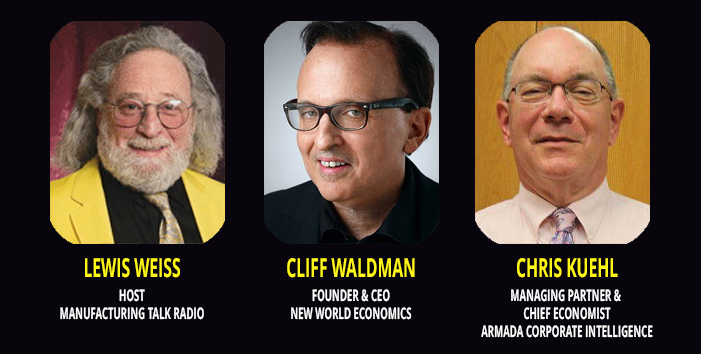
Good morning, everyone. This is Lew Weiss from Manufacturing Talk Radio. We're back. We are back and we have been off the air for about a year due to all kinds of issues, but we are starting our 10th recording year as we continue to go and grow. Today we have a wrap up discussion of what 2025

the year 2025 was economically and what the potential forecast and tariffs and all of that stuff going forward for 2026. Today I have two gentlemen who've been on manufacturing talk radio many, many times. This is a first, this is a television first, radio first, podcast first, I don't know, having these two guys on at the same time. So Cliff Waldman.

is with New World Economics and Chris Kiel is with Armada Corporation, Corporate Intelligence. Sorry, I screwed that up, Chris. I'm gonna let the two of you take a minute or two and give everyone a little bit of a background about who you are and what you are and what you've done and what you're gonna do. So Chris, I'm gonna start with you.

Chris Kuehl (01:27.016)
Very good. Well, thank you. the managing director, one of two, of Armada Corporate Intelligence. We are 26 years old. Used to be a professor of economics and finance. And one day I woke up and said, how come I talk so much about money and don't make any? So I decided to start my own company. We do a lot of public speaking. We do a lot of publications. We have several that are own.

and then we also do publications for other associations. go out about 125, 130 times a year to give talks primarily to manufacturers, but also accountants and bankers and construction companies and some that are just downright odd, like the Casket and Funeral Supply Association. Now, that's an interesting group, but it was one of those that showed me definitively

that you cannot really say anything about the economy that applies to everybody. During the pandemic, everybody was suffering except them. And they came up and said, well, son, dead people are good for us. you know, as the old Scottish proverb says, it's an ill wind that blows nobody good.

Lew (02:47.242)
Well, thanks for that, Chris. That was really very uplifting. Liff, why don't you give us a little bit about you and New World Economics.

Chris Kuehl (02:49.588)
Ha ha ha

Cliff Waldman (02:59.909)
I've been a Washington economist since 1994. Hard to believe I've been in DC for more than 30 years now. And before that, I was a state government economist in New Jersey, a state I think you know a lot about,

did my graduate work in economics at Rutgers. My two areas of expertise in economics are manufacturing, where I've done research, publications, speaking for more than two decades now, and small business and entrepreneurship.

Prior to launching New World Economics in roughly 2019 when we officially launched, I worked for the Manufacturers Alliance for Productivity and Innovation. We had a very strong economic research group and I did a lot of work on things that mattered in manufacturing, demographics, productivity, automation, etc. I have international relationships. I've had a long relationship with South Africa.

I spoke at a small business conference in Johannesburg, South Africa.

2022. New World Economics is mostly focused on the economic research and data development needs of manufacturers, but we've done other things as well. We've recently looked at the impact of the Trump tariffs on worker safety. We've looked at the evolving economics of cannabis, which is now officially a very big issue. And we're continuing to grow. New prospects

Cliff Waldman (04:41.683)
coming along all the time and I'm hoping that we'll have a very robust economic research firm for manufacturers. interestingly, it's been expanding even beyond the manufacturing realm, which I think is good.

Lew (04:55.36)
Great, thank you. I do have a disclaimer to make regarding politics. We as a policy matter at Manufacturing Talk Radio, we don't talk politics because we know we're going to lose

50 % of you if somebody gets insulted. So we make a point of not talking politics. That being said, talking about economics in the US economy and tariffs and reshoring and all of those other things that make up the topic of today.

Politics might slip into this conversation. We're not trying to, nor do we want to offend either side, left or right. That being said, gentlemen, let's kick it off.

Let's talk about 2025. It's been a wild and ruckus year. Actually, me personally, I'm looking for a calmer 26, but let's see how it goes. Gentlemen, Chris?

Chris Kuehl (06:12.244)
Yeah, mean 25 has been an interesting year. We're ending up a lot stronger than we thought we would be. I mean the latest GDP numbers came in and they were exceeding even the optimistic numbers that were coming from GDP now a week ago. So this is the first iteration. There'll probably be a revision in another couple of weeks. We'll see if it goes up or down.

Lew (06:14.299)
Thank you.

Lew (06:19.456)
Okay.

Chris Kuehl (06:36.254)
But it's a really good indication and I don't mean to go off on a tangent but I try to make a point of how big this country is and we know that it's big but our GDP is bigger than China, Japan, Germany and the UK combined. So at any given point in the United States there is a state that's in recession. There is a state that is booming. Moody's came up with a study not long ago

that said there were 23 states that are on the verge of recession and that was the headline. But I looked at it and said, well, you could also have led with there are 27 states that aren't. So what exactly is the conclusion to reach from here? And when you work in a world of data like Cliff and I do, you end up realizing that it's the local data that often matters the most. That when you're looking at the United States GDP,

Well, includes California. California all by itself is the ninth largest GDP in the world. So if they're having a good year, it makes it look like we're all having a good year. Does it matter to Mississippi that California is having a good year? Probably not. So we end up having to be a little bit more careful about making grand statements. And kind of to your point about politics, we don't talk about politics in a partisan way.

Politics plays a role in everything in economics, but it's it's like my German friends. I love Deutsche Welle, you know the German approach to things This happened whether it is good or bad is for you to decide it just happened

Lew (08:17.92)
A good rendition of a German accent. Cliff, give us a little insight into your backward look at 2025.

Cliff Waldman (08:35.825)
Well, Chris looked out over space.

the space of the United States economy, the United States geography, I'm gonna look at it over time. And I would suggest that the best way to understand 2025 is to go back all the way to 2020 because we have had a five years of volatility and confusion, the likes of which are unprecedented in the modern era. An historic pandemic and inflation surge, the likes of which we haven't seen since the late 70s, early 1980s.

Chris Kuehl (08:55.284)
Mm-hmm.

Cliff Waldman (09:09.469)
chaos is about the best way you could put it. And a government shutdown that was the longest in history and that clouded data that we very badly needed right now to see where we are and to see what 2025 looks like. I think what we have experienced is a year where you can't pull out any one data point or even a series of data points and say that's what it is. But we've had a lot of confusion. We've had a lot of volatility.

great uncertainty with tariffs and it will remain great uncertainty with tariffs. We are not sure what the Supreme Court is going to do with tariffs and that is a major issue for 2026.

Chris Kuehl (09:45.096)
Uh-uh.

Cliff Waldman (09:52.638)
a consumer that has not been particularly confident in the American economy, growing concerns about affordability, but yet data that are better than we expected on the growth side, although on the job side they have been weak and that brings up another mountainous force this year that's been AI. AI investment has made

street a very different world from Main Street. We don't know what it is. Is it a bubble that's gonna burst? It could be. We've seen that before. Is it going to create a huge productivity thrust? It may or may not. We don't, you know, often these things are disappointing in their early stages. We thought the internet was gonna, you know, create and computers were gonna create a productivity thrust. They helped but they took time. So this has been a

year of volatility and I think you have to think about 2025 from the perspective of the past five years, not just the perspective of this year.

Chris Kuehl (11:01.62)
Yeah, and I think there are some trends that have been playing out for that whole five years. We talk a lot about the demographic collapse that's coming at the end of this decade. You've heard economists talk about the mother of all recessions and I've been on panels with them and I said, come on guys, you can't even predict till next Tuesday, much less 2030. Where did this come from? And they said, look, we're just trying to warn people. We're trying to warn that by 2030, every single boomer

will have reached retirement age. Now doesn't mean we all retire. We're boomers, we don't know what to do with ourselves. Look at Lew, he's still working. But we're facing, particularly in manufacturing, construction, transportation, we're losing workers and we're not replacing them regularly. When you look at the GDP numbers that just got released, like Cliff pointed out, it was driven by AI and medical.

Lew (11:37.47)
Thank

Chris Kuehl (11:56.7)
why is it being driven by medical because we're all getting old you know this whole past year it's like holy cow what happened at seventy two my body blows up and i'm in the hospital four times it was like i knew i should have gotten the extended warranty but you know it's too late now but that's affect factors that's been playing a role the entire five years and will continue to i mean twenty six

is going to be different in some respects but not a lot. mean a lot of the issues that we're dealing with now will be dealing with next year.

Cliff Waldman (12:31.803)
Lew, Chris talked about one end of the demographic spectrum, that is aging, that's quite critical. I want to take a minute to talk about the other end of the demographic spectrum, which is tremendous falls in fertility and birth rates, and not just in the US, but through much of the advanced world. And it can be a whole show. I mean, that is a complex topic, but at its root, it means

Chris Kuehl (12:41.288)
Mm-hmm.

Chris Kuehl (12:47.368)
Mm-hmm.

Cliff Waldman (13:01.727)
that our labor force trajectory is down, not up. And I think you have to understand AI and quantum computing and 3D printing and robotics in the context of a labor force that's by any account, by any reasonable prediction is going to shrink, is going to diminish. And that is playing a large role in both short-term and long-term business decisions.

especially in the manufacturing sector where labor force availability, labor force skills have been such an issue for so long a time.

Chris Kuehl (13:41.879)
Yeah, you extend that to the international and you realize that the average age in Africa, 60 % of the population of Africa is under the age of 30. You look at Iran, know, 70 % of the population of Iran is under 30. So the youth is not here and it's not in Europe and it's not in Japan. It isn't even in China. China is beginning to worry about demographics as well.

Cliff Waldman (13:53.021)
All

Chris Kuehl (14:08.84)
that one child policy has come back to hurt them and that's that's a sea change

Lew (14:12.298)
now.

Well, now there's a new policy happening in China where the one child policy, not only is it gone, but they are now paying bonuses for every child that's born going forward. So they recognize that they have an aging population and their economy is becoming a wild tiger and they want to grab hold of that tail and hang on.

Chris Kuehl (14:25.298)
Mm-hmm.

Chris Kuehl (14:29.246)
Yeah.

Chris Kuehl (14:43.684)
and you see that they're having the same problem other countries have tried that in the past too and interestingly enough the successful middle-class educated people don't want more kids so they're basically like no i've got a good job i went to college i want to spend my money on myself and so you end up with large populations of uneducated

Lew (15:03.732)
That was the...

Lew (15:08.564)
That's what makes them educated. They're realizing you can't have kids and have a good life.

Chris Kuehl (15:10.554)
Exactly.

Exactly, education equals selfishness. It's easy.

Lew (15:18.336)
Thank

So the government shutdown, aside from causing numerous issues and problems, one of the things, of course, is that we have not had sufficient data regarding our economy. And last week, they came out with the numbers. Our unemployment now is at 4.6.

inflation is at 2.3 and rising. What's your long-term prognosis on that?

Chris Kuehl (15:55.988)
Well, both of those numbers are still low. I mean, when you look at the employment historically, know, theoretically, if you go back to Econ 101, 6 % unemployment was normal. We haven't seen that in years. But it was a pretty minor, and even the U6 version of unemployment is still around 8%, 8.5%. It's usually about twice what U3 is.

Lew (16:08.704)
you

Chris Kuehl (16:20.028)
So it's not out of control, but the interesting thing about employment right now is that there's a lot of people that we don't quite know how to count. People who were in the gig economy, the Uber, Lyft, DoorDash bunch, they will frequently identify themselves as unemployed. You ask them, do you have a job? No. What you you don't have a job? You're in that car every day. Not a real job. Don't have a boss. Don't have to drive. So we don't know if they're employed or not. But they're making money.

So they're economically active, but we don't know how they're getting paid exactly.

Cliff Waldman (16:55.709)
I became more concerned about the latest employment numbers when we got the GDP report this morning. was much stronger than expected, 4.3%. Now there's all kinds of asterisks in there. mean, most of it was consumer spending. The investment was weakish in there. But what concerns me particularly is that we got a generally strong GDP report, yet for the three months of the third quarter,

Chris Kuehl (17:03.891)
Mm-hmm.

Cliff Waldman (17:25.663)
catching up now. But yet for the three months of the third quarter, employment growth, payroll employment growth, averaged just a little bit over 50,000. Now that's very disturbing. When we got, prior to the GDP report, okay, you know, we're going through volatility, through money here, we know how to, we generally understand how to juice economic growth. And then once we get the economic growth back, employment numbers will stabilize, we'll get back to the 150,000

50 to 200,000 that we need to employ new entrants into the labor force. But when you see a strong GDP number and very weak employment numbers, it suggests that there's a structural change in the labor market that is not favoring employment. And that's going to create a whole set of challenges for, again, not talking politics, but for policy that is going to create

Chris Kuehl (18:00.115)
Mm-hmm.

Chris Kuehl (18:15.934)
Right.

Cliff Waldman (18:25.439)
a whole set of challenges because if we can't employ people by means of strong economic growth, what should we do? How do we employ people? I think that the two of them together, again, it's one quarter, so take it with a grain of salt, but the two of them together, strong GDP, very, very weak employment growth is disturbing. It suggests a set of challenges on the employment front that we haven't confronted

Chris Kuehl (18:33.62)
you

Cliff Waldman (18:55.643)
before.

Chris Kuehl (18:56.466)
Yeah, we have a lot of people that are not capable of getting into the workforce. I mean, as much as manufacturing has complained for decades about labor shortage, and so you would assume, gee, there's a labor shortage, there must not be anybody looking for work. And then you look at the numbers and say, no, there's 10 million people looking for work. And they can't find work in manufacturing. 20, 30 years ago, that was not the case. Manufacturing was where you found a job.

Cliff Waldman (19:01.147)
Right.

Chris Kuehl (19:23.794)
when you had a high school diploma and limited education and you got your training on the job. Manufacturers don't have that luxury now. You have to be ready to go to work immediately. so, you know, Cliff alluded to it earlier, AI, robotics, technology, even the smallest job shops that I deal with now are investing in robots. They didn't used to. They used to just hire people, but they can't find them.

So they're spending money on robots. And when a 10 person job shop splashes out for a robot, that's significant. That's a change.

Cliff Waldman (20:00.742)
Let's put one bright spot into the picture here. Well, not bright, but hopeful spot here. With all the fears about AI that were somewhat similar, at least in tenor, to the fears about what computers were gonna do, the fears about what 3D printing was gonna everything was gonna replace job. One of the things that the internet did do is that it created a new platform for entrepreneurship.

Lew (20:01.021)
You know there?

Chris Kuehl (20:16.808)
Mm-hmm.

Chris Kuehl (20:27.262)
Mm-hmm.

Cliff Waldman (20:28.157)
since the late 1990s has fallen off, but it's picked up lately. Now part of that is the pandemic.

But it's gonna be, the one thing that people are not, we're asking about AI in jobs, how about AI in business startups? It may create an open platform for people to start new businesses. particularly within the manufacturing sector, we need entrepreneurship. Entrepreneurship in manufacturing has been sliding for some time now.

And I think if we think of AI as being an entrepreneurship platform for people who, know, that may be a better career direction than trying to get a job these days, it'll solve their problem and it'll solve a problem that the manufacturing sector has had for some time now.

Chris Kuehl (21:13.156)
solve their problem and it'll solve a problem.

Chris Kuehl (21:20.12)
Yeah, and I agree that one of the big advantages of AI is speed to market. When you look at AI, it isn't significantly different from what we have always done. I I used to compare AI to being a professor, and you had all these grad students working for you, and you'd send them off to get some information, and some of it would be good, and most of it would not be, and over time you would figure it out. Now you can do that in three hours.

Cliff Waldman (21:25.083)
Right.

Chris Kuehl (21:46.868)
and just by interrogating your AI platform. the biggest inhibition I used to teach entrepreneur classes and the biggest problem was speed to market. You would end up with a good idea, you'd have some good things in place, it would take you months to get it in place. You had to get that research in place. Now AI can give you all the research you need in a day and then you can hit the market running.

Lew (22:11.86)
Talking about employment, non-employment and so on, and the skill gaps that exist in our country today. There are a lot of programs today that are trying to offset immigration issues, deportation and that sort of thing, which in itself has caused an employment issue. Here in New Jersey,

have Community College of Morristown that built a manufacturing plant.

and they take in outside work, but the whole purpose of the program is to teach kids about manufacturing and the benefits of, which there are a lot. Steady job, high income, company benefits, healthcare, actually healthcare, my wife told me last night in discussion she and I had that we're spending $23,000 a year in healthcare. I had no idea and I told

Chris Kuehl (23:18.472)
Mm-hmm.

Lew (23:20.354)
don't ever tell me that again. I just don't want to hear about it, especially at the ripe old age of 82. I don't want to talk about healthcare. But the point is that the Community College of Morristown has a couple of hundred students in their class, and they're actually expanding their program and building another building, going to be building another building.

Cliff Waldman (23:22.193)
Yeah

Chris Kuehl (23:22.324)
Exactly

Lew (23:50.386)
Somewhere actually at the end of January, I'm going to be out on location and we're going to be talking to the head of the program because this is what government, local government, local state government have to invest.

We need, everything is manufactured. There is nothing that's not manufactured. We even had two years ago, we had one of the people from Paramount on talking about movie manufacturing. Everything is manufacturing and is critical to our economy that we plug the holes in the dam and make sure that we are bringing the kids into a new era and naturally

the digital world. My granddaughter, she graduated college at 22 and got a job well into the high five figures and I was shocked. Actually, she shocked me more when she was complaining that she has to pay taxes.

Chris Kuehl (24:58.472)
Ha ha ha.

Lew (24:58.782)
Dad, do you have any idea how much I'm paying in taxes on my Ica? I said, yeah, I said that's what keeps the ball rolling. So there's all kinds of things going on with regards to employment and.

Chris Kuehl (25:12.564)
And we might not be able to go back to things, mean, when you get to be a rival age, in my case 72, you remember high school. And when I went to high school, this was a working class school in Kansas City, and almost 60 % of the kids that were in high school were going to go directly into work. They were not going to go into college. They were not going to go into junior college or anything else. It was a manufacturing part of town.

Lew (25:20.959)
Good.

Chris Kuehl (25:40.276)
and and eleven o'clock every morning half the school left to go to work in these manufacturing plants that was there that was their curriculum so the assumption was that you were going to put at least half of your high school graduates in the work in the manufacturing and good jobs i mean it was companies that don't even had armco steel for god's sakes uh... in in kansas city which employed

five thousand people at one point. Well, now it's the rare school that has industrial arts. It's down to five percent in the United States still have industrial arts and you're churning out lots of kids to, you know, go on to college. We're not quite sure what it is they're going to major in. We're learning from the student loan fiasco.

Lew (26:09.92)
and God.

Chris Kuehl (26:34.472)
that if you got a degree in underwater Greek literature, you're going to have a hard time paying that loan back.

Lew (26:40.528)
Right, right. One of the things that we ran across last year

when talking to newcomers into the workforce. One of the things that we need to do is educate the college graduated parents about their kids that maybe the best route is not going to college to become a school teacher and make $40,000 a year. You can become a oil rig.

Chris Kuehl (27:03.39)
Mm-hmm.

Lew (27:16.672)
person manufacturer and make $150,000 and only worked 30 days on and 30 days off. We had somebody who told us that story.

Chris Kuehl (27:28.584)
And then there's the two brothers I know. One of them has a law degree and the other is a plumber. And the guy with the law degree is always borrowing money from the plumber.

Lew (27:38.068)
Perfect example, perfect example. But I think that there is a lot of programs going on now in the education sector to help educate parents as well as students the benefits of rethinking education. And I think it's long overdue and I think it would help the economy tremendously if in fact.

Cliff Waldman (28:06.415)
And some of that discussion, Lew, is the active participation of manufacturing companies themselves in the industry, having apprenticeship programs, which has been, know, number of think tanks in DC, will tell you, have been thinking quite...

Chris Kuehl (28:15.919)
Exactly.

Lew (28:20.339)
Absolutely.

Cliff Waldman (28:26.045)
profusely about this because they need These companies cannot have got to stop complaining. They can't find people they have to they have to groom people they have to create a you know a company a University to give give what us economists refer to as firm specific human capital to you know to function in in in that company and I think that's a trend that I Given what's going on that is going to accelerate more

Chris Kuehl (28:35.976)
Mm-hmm.

Cliff Waldman (28:56.199)
where manufacturers themselves are not waiting for human capital that is trained and educated in a certain way, but is going to actively participate in their education.

Chris Kuehl (29:08.498)
Mm-hmm.

Lew (29:08.704)
I'm

Absolutely. last year we did speak with two companies in Vermont, manufacturing companies who are having severe problems because the kids that grow up in Vermont leave Vermont. They only go home to ski on those rare weekends in the winter. What they did was they couldn't, there were no people. They couldn't get people. So what they had to do was attract people from out of state to come into Vermont. And what they did,

these two organizations, they made a pact that each one would share in educating and apprenticeship programs within their two organizations and

to bring in kids from out of state, and it worked. And the only proviso was that they both agreed with each other not to steal each other's employees when the program was over. But it was very successful, and they brought in, there was something like a 60 % increase in kids coming from out of state who

Chris Kuehl (30:07.156)
You

Lew (30:22.024)
wanted to go into an apprentice program, wanted to go into a state where they were skiing, and they had a great two-year program.

Chris Kuehl (30:31.604)
Kansas is doing the same thing because if you think there's a labor shortage in manufacturing, try agriculture. You know, this is an ag state and 70 % of the state is dependent on ag and they cannot keep kids in these small towns. So there's been a really aggressive effort by the high schools, by the community colleges to recruit and they are. They're recruiting from all over the country.

Cliff Waldman (30:38.587)
Yeah, yeah.

Lew (30:52.672)
Thank you.

Chris Kuehl (30:58.566)
and finding you know people interestingly enough it's often young families where you've got the young family young kids who are like no i i don't want to grow up in chicago i don't want to grow up in detroit i don't want to grow up where i think things are dangerous i'm gonna move to great band haze dodge city yes i understand that dodge city you know that you're getting close by the smell of money it's it's the thoughts but hey it's it's work

Cliff Waldman (31:28.605)
you

Lew (31:29.46)
Well, it's a great conversation and it's great topic. And I think that we still have a lot to talk about. So we may wind up doing this as a part one, part two event. And let's continue our discussion in regards to what's coming in 2026.

We've been talking about 2025 back to 2020. Let's talk about some of the things that we've talked about that may grow sooner into 2026 and see how that might aid our economy and the people and so on. So gentlemen, 2026 is upon us.

Chris Kuehl (32:13.446)
Alright, I'm going to throw some of this to Cliff because I think because it's an election year that there's going to be a lot of governmental type programs coming out to encourage or stimulate or do something for the economy. We've already seen, for example, the $12 billion being offered to the farm community. Kind of a drop in the bucket, but it's a gesture.

but this is the time of year where you get a lot of that and since he's been in the bowels of washington for a while he can probably speak to that better than i can

Cliff Waldman (32:47.889)
Well, I'm going to start my 2026 discussion with on the international front because that's so important to other manufacturers. Now, there's a lot of, I mean, the Trump tariffs have created a lot of volatility around the world and there's a lot of interesting things going on. The rise of India.

Chris Kuehl (32:54.504)
Mm-hmm.

Cliff Waldman (33:07.261)
possibilities in Africa. in terms of concerns, I want to talk about China. I think the biggest concern, at least to me, on the international economic front is what's happening with China. It is very possible that we don't have full data for the second half of 2025, but it's very possible that their growth may be half of what they planned it to be. Now, you have to sort of divide this into two parts. Their exports remain, particularly high tech exports, remain

Chris Kuehl (33:28.731)
Mm-hmm.

Cliff Waldman (33:37.228)
fairly competitive. But domestically, there is a lot of concern about even the short-term outlook for the Chinese economy. And there's a number of things going on. We talked about demographics. They have a declining birth rate and fertility rate and an aging population. For many years, there's been a concern that China was going to grow old before it grew rich. I published a paper on this in 2007.

it's been around for a while. Also, their property bubble has basically burst. It didn't have the same kind of financial crisis that we had in the West, basically because they have much higher savings rates. But we are seeing the economic residual. Well, what is essentially has been a property bubble burst, and that has taken down fixed asset investment, which I'm actually afraid to look at the latest numbers on fixed asset investments.

Chris Kuehl (34:09.172)
So the property bubble has basically worked.

Cliff Waldman (34:36.991)
So China is remains very strong concern for the global picture. And of course, China has very long legs. It matters a great deal to Europe, has been a Europe has been a little more resilient than people think. China matters a lot to Europe's growth and Europe matters a lot to Canada and Mexico and therefore the United States. So I think the

Chris Kuehl (34:37.108)
So.

Lew (34:37.938)
Thank

Chris Kuehl (34:41.236)
Sorry.

Cliff Waldman (35:06.911)
The global economy has more risk than reward right now. So I think we're going to see some of these global economic difficulties reaching a higher pitch in 2026. Some of that will depend. Again, hate to keep coming back to that, but if the Supreme Court knocks down the Trump tariffs, and that's going to matter a lot to the picture, that could change the picture.

But right now, the global economy is a concern for 2026.

Chris Kuehl (35:40.181)
Yeah, and some of the advantages that you point out that China has had are detriments in another way. I mean, one of the ways that that property collapse has not affected them is their savings rate. But that savings rate is what's been interfering with Xi's attempt to get the consumers to take over the growth of China. When he took power, he wanted to reduce that export dependence by getting the Chinese consumer to spend, like American consumers do.

nobody spends like American consumers spend. mean, we love to shop. China has not picked up the ball and that has let their economy shrink. Then you look at the tariff policies and so many of them are not just economic. I tariffs have lots and lots of functions. They're generally used as negotiating tools and you're trying to get a country to do or not do something using the tariff. And so,

beginning of the year very generous towards india we wanted india to replace china then we got mad at india because they were buying oil from russia supporting the ukraine war so now india has higher tariffs than china you know we put huge tariffs on brazil which has driven the price of copper to all-time highs twelve thousand dollars a pound and that's ridiculous and is it because we're protecting china or u.s. copper production no

It's because we don't like what the Brazilian government is doing to its previous president, who was an ally of Trump. So we've been punishing Lula, saying, quit picking on Bolsonaro. Well, that means we put tariffs on coffee and copper and chocolate and ethanol. So did it help Bolsonaro? No, he's in prison. Has it hurt U.S. copper users? yeah, I mean, these prices are outrageous.

and that's the problem with tariff. It doesn't just have one thing. It's designed to do a lot of things, but it has unforeseen circumstances. My favorite law of economics is the law of unintended consequences.

Lew (37:51.892)
The situation we have in this country right now with regards to copper being that you brought it up is that we have a serious shortage of copper. And everything that we're doing in the new digital world and technology is about copper. We need copper in everything that we do. And so by instituting a severe tariff on copper,

Chris Kuehl (38:00.829)
Very serious.

Chris Kuehl (38:11.315)
Yeah.

Lew (38:22.186)
kind of slams our own country unmercifully.

Chris Kuehl (38:24.308)
And that's one of those things where you look at international politics and that could change really fast because Chile now has a new president who is not a left-wing president. Gavrilo Buric was a former student labor leader. He's gone and he's been replaced by the most hardline conservative Chile has seen since Pinochet, which is probably going to open up the copper market as far as the US is concerned.

Lew (38:33.215)
yeah.

Chris Kuehl (38:53.768)
To Cliff's point, we tend not to pay as much attention to international because we're so preoccupied with our own deals. But what happens in Europe, what happens in Chile, what happens in Indonesia, what happens in Japan matters and it matters dramatically to us.

Lew (39:14.942)
We have close friends in Europe, and there still is a Europe, but we don't hear a whole lot about it, about what's going on there and their various economies. In order to get any news about Europe, you have to listen to the BBC. You can't get any European news on US network news. That goes without saying.

Chris Kuehl (39:41.789)
well but my favorite here's my plug my favorite I listen to BBC too but my favorite is Deutsche Welle the German version of BBC because it's so typically German you know it's like these people died did you know them? No? Then who cares? so it's just typically German

Lew (39:49.886)
Yeah, I like watching.

Lew (40:01.098)
Yeah. So what's happening in Europe? What do you see? They're angry at the Americans. They're angry at our politics. They're deciding not to. Well, that's been going on for millennials. But the bottom line is that Europeans are not coming to the United States. Our tourist industry is being mercifully

Chris Kuehl (40:11.368)
They're angry at each other.

Lew (40:31.038)
whacked, including from Canada. You know, the state of Florida, Mr. DeSantis says, oops, I'm sorry, I said something political. The Florida economy is built on tourism. Well, the Canadians said, you know what, we're not coming. And they're not.

Chris Kuehl (40:54.364)
Yeah, what's interesting about Europe right now is that Germany is still in recession. It's been in recession for number of years. But the interesting thing is that countries that have been kind of the sick men of Europe are now the stronger ones. Italy, Spain, doing much better than people expected. Britain is still struggling. France is still struggling, but...

Cliff Waldman (40:54.726)
I

Chris Kuehl (41:17.772)
Europe is a lot like the US. We're seeing a lot of division depending on where you are. The Eastern European countries are kind of almost experimenting with what do we turn into as we try to transition into something. know, Poland is stronger than it has been. Hungary is getting weaker.

Cliff Waldman (41:40.038)
Germany and the UK, the problems are very fundamental. It's not just a slump that they're going in and out of. They really need to rethink their economic policies. Germany missed the boat on investing in advanced manufacturing. They really got behind that, and they got, therefore, competitively behind. But, again, while we don't talk politics, I think to understand Europe and the economic, you know,

Lew (41:40.384)
So.

Chris Kuehl (41:50.095)
Absolutely.

Chris Kuehl (41:55.72)
Mm-hmm.

Cliff Waldman (42:08.973)
shock waves coming out of Europe, not shock waves. You have to think geopolitics a little bit and therefore Ukraine matters economically because what it's doing is to the extent that it's causing strains in the NATO alliance, that's going to have economic reverberations with us, with our trading, with our...

Chris Kuehl (42:17.138)
Mm-hmm.

Cliff Waldman (42:31.129)
effort at G7 or G20 strength. And also it doesn't help that we keep, and again, I know we want to avoid politics, but it matters to economics that we keep souring our relationships that are important. And I'll give you two extremes. Canada,

is a lot to our economy. They are our largest trading partner. There are millions of jobs that depend on exports to Canada. And to the extent that that is at least compromised, anywhere between compromised and threatened, that's gonna matter to our jobs picture, those jobs numbers that we hopefully will keep getting on a monthly basis. It also doesn't help that in spite of obvious concerns about South

Lew (42:58.592)
You bet.

Chris Kuehl (43:24.02)
Despite of obvious concerns about South Africa, you need to keep South Africa in

Cliff Waldman (43:26.687)
We need to keep South Africa in our area of friends because Africa, as Chris pointed out, that's where the labor force trajectory is positive. That's where manufacturers can see positive investments from a positive labor force.

Lew (43:43.527)
you

Cliff Waldman (43:46.11)
So, you know, we need to think smarter about our relationship because if we keep souring on Canada, keep souring on Southern Africa, it's going to come back to haunt our manufacturing growth and eventually to our job growth.

Lew (43:54.464)
you

Lew (44:00.192)
you

Chris Kuehl (44:03.41)
Yeah, when you talk about China and how it's going to react to its threats, they have very aggressively been developing relationships in Africa, in Latin America, in South Asia. Fortunately for us, if we can take advantage of it, the Chinese can be pretty ham-handed about getting involved with other countries. My African contacts say that China is constantly referred to as the new colonialists, you know, that they come in and exploit the heck out of the country and then leave.

but the point is they're putting a lot of money into africa a lot of of development in specific countries i mean that we tend to look at africa like it's one country it's forty seven and you know some of them are very very different you know what's going on in places like but one in the video and guy on a and guinea i mean there's very very different performances and then we start looking at

our dependence on, you we just tried to broker a peace in the Democratic Republic of Congo for the 85th million time because they have what we want. They have cobalt, they have copper, they have uranium, they have all in the Katanga province and that place has been fought over since time immemorial. So, and it will continue to be.

Lew (45:25.374)
The Canadian issue being that they are our number one trading partner, we might have to rethink our policies that we've imposed upon them and recognize that, and Canadians don't like hearing this, but they are sort of our 51st state. And I know we want to buy them.

but I don't think that's going to happen. But the point is that they are our 51st state and 20 % of our trade goes either to or from Canada. So I think our DC folks need to get a grip on who's who and who's what and who needs to do what for their best interest.

Chris Kuehl (46:19.25)
And we kind of forget what we were trying to do 10, 20 years ago. mean, when NAFTA was being developed, the whole idea around it was we needed to counter the European Union. That Europe was uniting. Europe was, and now they haven't done as good a job of it as they would like to, but that was the idea. Is to create a common economy, you know, France and Germany and Italy and Britain all pulling in the same direction. Our response

was to create a North American economy. And that was working for us very well. And now we're sort of allowing it to fray, because it's not only our relationship with Canada that's strained, our relationship with Mexico is strained. And when you start looking at things like the workforce, unless we're going to suddenly change the retirement age to 96, we're going to have to recruit younger people. And they're likely to be coming from south of the border.

and i'm have worked with a lot of companies polaris has an operation in minnesota and they have one in monterey and they are constantly trying to get people in monterey to move up to minnesota to work at their plant except that they're from mexico and they said senior we get the weather channel down here white white white white white don't you move here are rather than us go to minnesota

Lew (47:42.004)
for the Mexico.

Cliff Waldman (47:42.184)
Big implications of all this for our auto industry. For Canada and Mexico, the North America, Canada story for our auto industry. There is no such thing as an American made car anymore. It just doesn't exist. mean, cars cross the border between the US and Mexico and the US and Canada multiple times before it becomes a finished product. So we are essentially by...

Chris Kuehl (47:45.576)
Yeah.

Chris Kuehl (47:53.873)
No, no.

Chris Kuehl (48:02.888)
Yeah.

Cliff Waldman (48:07.985)
say decimating, but by seriously compromising our relationship or economic relationship with Canada and with Mexico, we are seriously compromising the vitality and the competitiveness of the North American auto industry, downstream impacts on many manufacturing industries even just besides autos.

Chris Kuehl (48:24.467)
Yeah.

Chris Kuehl (48:31.816)
Yeah, I agree, and it's rectifiable.

Lew (48:34.08)
One of the things about Mexico, however, is they've got inherently a crime problem. The U.S. Department of State has now put certain areas in Mexico, only within the last two weeks, put them on the do not travel list. And that's a problem. And they're not dealing.

They're not dealing well with the crime, which of course is all based on the cartels. And we're doing our best to shoot the boats out of the water from Venezuela. But maybe we need to do something more proactive in helping the government down there with regards to their crime problem.

Chris Kuehl (49:20.882)
And even when you look at the crime problem, I've done many conferences in Corretero, which is a manufacturing town, and you ask them about the drug problem and they just laugh and say, we don't have one here. He said, no self-respecting drug lord wants to be in charge of the Pittsburgh of Mexico. He said, this is not Acapulco, it's not full of tourists, it's not full of... He says, who do you think is buying all these drugs? You are.

Lew (49:28.32)
Mm-hmm.

Lew (49:33.512)
Right.

Lew (49:48.672)
Americans.

Chris Kuehl (49:49.169)
and you know so if if you stay away from the tourist areas so part of the lesson is you go to correct the road and it's a whole different mexico i mean it was so funny everyone about nine o'clock at night kind of where we're going to go from here and they all look at it's like home we have to be a work tomorrow at eight you know this is a manufacturing town we're not going to party until one o'clock in morning are you nuts it's like you people are boring i know we're manufacturers what do you want

Lew (50:22.88)
Gentlemen, this is very enlightening. I think that we need to look at this.

show that we're doing today is possibly a regular broadcast that we do once every three months and give the quarterly update into Q1, Q2, three and four in 2026. And I think that would be really a great barometer for our audience as to what's going on.

Chris Kuehl (50:58.15)
and then people can laugh at how how off we were you know

Lew (51:02.26)
Well, that's true. But that's your issue because PhD means piled high end diap- I was going to say piled high end diapers, but that's true.

Chris Kuehl (51:08.751)
And, like, exactly.

Chris Kuehl (51:13.69)
yeah yeah yeah you know just make cracks about our age go ahead

Lew (51:19.172)
Yeah. Any final comments, Cliff?

Cliff Waldman (51:25.981)
I think everybody is now, there's a lot of questions about 2026. I think there's a, 2025 has been a year of tremendous uncertainty.

I think we're have a lot of uncertainty in 2026. I'd like to say that it's gonna calm down, that it's gonna be a stator year. I don't think so. There's too many unanswered questions. Too many points of abrasiveness and sharpness. We're not sure which way it's gonna go. So I think manufacturers, business people have to be aware of both the volatility and the uncertainty that I think is gonna spill over from 2025 into 2026.

Lew (51:47.168)
I wouldn't matter on it.

Cliff Waldman (52:10.527)
Which I can say otherwise, but that's my general prediction.

Chris Kuehl (52:11.558)
Yeah.

Yeah, that would agree, and I think you compounded because it is an election year. And so you do tend to get a lot of policy experiments during an election year. And we also have to bear in mind, back to the international thing, that there's been transition in other places too. Japan has a new prime minister. The British government is not particularly stable. You've got challenges taking place throughout Eastern Europe. You have the rise of

of kind of the populist movement in Europe as well as here. All of that's going to play a role and as we go into 26, it's going to be, I I always laugh when people say, you know, what do think next year is going to be like? Like, economics pays no attention to calendars. It doesn't matter that it went from December to January. It's the same issues that we've been dealing with and

With any luck we start taking some of these a little bit more seriously but it's a slow process.

Lew (53:15.21)
There is one point that we did not bring up, and I think it was just by omission. And I'd like to just hear a couple of comments on the Ukraine, which of course affects all of Europe and in many ways the United States. So we're...

Chris Kuehl (53:24.883)
Mm-hmm.

Chris Kuehl (53:30.586)
yeah i think you know that goes back to my i started out as a soviet specialist back in the eighties ukraine similar to many other eastern european countries it never made a great deal of sense as a country so the process of that we're seeing in ukraine similar to what happened in yugoslavia and i mean we had a ten-year war trying to decide how those states were going to czechoslovakia

they at least had a good sense to split amicably and basically say look we don't like slow box it for checks we don't like checks of for slow box let's just split ukraine has always been split between a russian eastern side and a ukrainian western side and it unfortunately is having to be worked out violently there will be i think some kind of a settlement which is really going to make anybody very happy because ukraine will lose

part of its eastern section. almost has to. Europe is trying to figure out how to bail it out but they don't have the wherewithal or the money to do that.

Lew (54:28.948)
without having to have.

Cliff Waldman (54:39.291)
Let me make two points, on this. Let me look at the Russia side of that story. And the Russia side of that story is a testament to how difficult forecasting is even over the long run. Remember when the New World was coming out, we had Gorbachev, we had Yeltsin, we thought Russia was moving forward to become a modern, not Western, but at least a modern state.

Chris Kuehl (54:44.275)
Mm-hmm.

Lew (54:46.421)
Good.

Chris Kuehl (54:58.856)
Mm-hmm.

Cliff Waldman (55:09.215)
We didn't think about Putin when we were looking at Gorbachev and Yeltsin. Now, so that's one thing. So it's a testament to how difficult human forecasting is. Second of all, however Ukraine gets settled, if it gets settled, we cannot appear to be rewarding Putin.

Chris Kuehl (55:20.072)
Mm-hmm.

Cliff Waldman (55:31.761)
for this kind of behavior. Because if he do, he won't stop with Ukraine. And we will have a threatening cloud over Europe that is going to have significant economic consequences.

Chris Kuehl (55:33.298)
Mm-hmm.

Alright.

Chris Kuehl (55:45.461)
no agree we have to remember that there's several of the east european governments right now better pro-putin and if he gets away with ukraine it won't be a big stretch for countries like slovakia or hungary to going back to the orbit and that suddenly compromises west european security and they worry about the baltics and i mean yeah it's it's uh...

very difficult mess. Europe is trying to step up, even with the commitments they've made to future military buildup, it's going to take years before they get to a point where they can defend themselves.

Lew (56:26.964)
Well, I think that 2026 will tell its tale in about a year from now. Hopefully, some of the ideas and predictions that we put forth either do happen or don't happen. But I think that you're right about some of the Russian comments made here. That being said, terrific show, great topics.

I really appreciate the two of you being here today. I also want to remind you of my comment that you heard for the first time about us doing a quarterly recap of what's going on in 2026, Q1, 2, 3, and 4. But we'll discuss that off air. Gentlemen, thank you very much. Have a good holiday for the two of you.

Washington, D.C., go see the Christmas tree at the White House. I don't know, is it white this year or blue?

Chris Kuehl (57:26.676)
He

Cliff Waldman (57:27.581)
you

Chris Kuehl (57:32.34)
I'm just working on the tree in my own house.

Cliff Waldman (57:32.621)
It, I, I...

Lew (57:35.344)
All right.

Cliff Waldman (57:37.945)
I haven't seen it up close in person. I think it's blue this year.

Lew (57:40.828)
I think it's blue because they got chastised last year for the all white one. So gentlemen, thank you very much. And to our friends and audience listening today, tune into Manufacturing Talk Radio on a regular basis. If you like the show, hit the like button. If you have comments about the show, please spare me your political views.

Cliff Waldman (57:49.213)
Thank you.

Lew (58:06.016)
And lastly, I think that anyone who has a story to tell regarding manufacturing, let us know. Manufacturingtalkradio.com. You can reach out to us and contact us through our emails. And I wish to thank everybody who's been here today. Thank you very much all. And I bid you adieu.

 Spotify
 Apple Podcasts
 Podbean
 YouTube
 Spotify
 Apple Podcasts
 Podbean
 YouTube