TRANSCRIPT
Cliff Waldman (00:01.106)
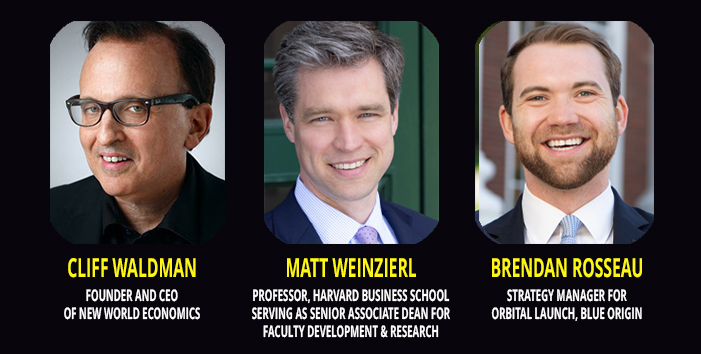
Good day everybody and welcome to this week’s episode of Manufacturing Think Tank with Cliff Waldman. I’m Cliff Waldman. the host of this show, one of many on Manufacturing Talk Radio. This is the third episode in our new season of Manufacturing Think Tank. In the first episode, we looked at the impact of the Trump tariffs on manufacturing. In the second episode, we considered the emerging technology of quantum computing.
In this episode, we are going to look at a sphere. can’t even call it an issue. A sphere that is increasingly in the news, increasingly a part of our lives, and very much a part of our collective futures. And that is space. I am pleased to be joined by two leading experts on the emerging space economy. Matt Wines-Earl is a professor at Harvard Business
School, serving as Senior Associate Dean for Faculty Development and Research and the Joseph and Jacqueline Eppling Professor of Business Administration. He’s the founder of the Economics of Space project and the space course at the Harvard Business School. And he serves as a frequent advisor on space to government agencies, companies, and investors. He’s a research associate at the National Bureau of Economic Research. And previously, he worked at McKinsey & Company and the White House
Council of Economic Advisors. Throughout Matt’s work, he seeks to use the tools of economics to help humanity responsibly realize the promise of space. we’ll be talking about this today. Brendan Rousseau is a strategy manager for orbital launch at Blue Origin, which you might have noticed has been in the news lately. He previously served as a teaching fellow and research associate at the Harvard Business School and as a consultant with Blues Allen and Hamilton.
supporting Space Systems Command. He has been recognized by several industry groups as a leading young professional in the space industry and is dedicated to using space technologies to bring about a more prosperous, peaceful, and expansive future. Gentlemen, welcome to the program.
Matt Weinzierl (02:17.681)
Thank you, Cliff. What a pleasure to be with you and with your listeners. for your listeners, Cliff has been a generous interlocutor with us over the years about space. And so it’s great to be able to share a bit of our conversation with all of
Cliff Waldman (02:31.176)
Thank you, thank you. Brendan, I want to start with you on the first question.
I have to tell our audience that Matt and Brendan just put out a book. It is called Space to Grow, Unlocking the Final Economic Frontier. I have read it. We’re going to use it as a springboard for today’s conversation because it’s a fountain of the latest ideas, the latest issues in this growing part of our lives and our futures. So Brendan, just to start with you, in large part, the evolution of the space sector as you and
Matt described it in the book seems to be basically a story of very, very high risk taking in its purest form, a story about making large bets on the unknown. Do you?
think that this kind of entrepreneurial drive for space can be maintained in the face of a lot of challenges today, some of which include tariffs, debt, geopolitical strife, lack of confidence in our government institutions? Can that entrepreneurial thrust into space be maintained enough to really realize the promise of space?
Brendan Rosseau (03:47.065)
Sure, it’s a great question and first of all, thanks for having us, Cliff. It’s really a pleasure to be here. I’d say that the story of the space industry today, where it’s been and where it’s going, is really kind of a coalescence of two stories. Since the original space age, 1960s to now, we’ve really pioneered all kinds of space technologies that now in the 21st century have become critical to the modern way of life. Everything from position navigation and timing,
GPS, it’s integrated into our daily life in a remarkable number of ways. So what we’ve learned in the past 50 years is that space is really essential to what we do, to our homeland security, to our economies, and like I said, our modern way of life. But the traditional model that we’ve used for space, which is at least in the United States, it’s government run, government led, fielding out certain activities and operations to contractors as necessary.
really it’s been kind of a central government dictated approach, which worked really well in the Apollo era, maybe showed some cracks in the space shuttle era and beyond where the efficiencies that we needed just really weren’t there. And so the story of today has been a balancing of the public and private sectors, bringing in the private sector to see if the market can bring about new efficiencies and innovations that can take what space can do for us back here on earth to a whole new level.
In the past decade and a half have really been exciting. We’ve seen a lot of the promise of bringing the space industry in and letting it lead in certain areas, especially in launch and then now with capabilities like SpaceX’s Starlink and communication satellites. So it’s really been remarkable to see, yes, this model has some promise. But as you mentioned in your question, I think there’s a lot of unknowns on where we go from here. One of them being, well, just how much value is there out there in space that we can generate for us back here on Earth? I think most of us in the industry believe
that value is huge, but also how do we get there? And that’s a real tricky question that I hope we get to talk about.
Matt Weinzierl (05:52.573)
Cliff, could I add just a thought on that? That was a great answer, Brendan. And then I’ll just add one element of it, because Cliff, you were also mentioning some of these threats that maybe come from outside the space sector and raise the level of uncertainty. And I think that’s a really important topic. mean, of course, risk taking is always harder the more risk there is outside of the place where you know the most. And so all the factors you mentioned could definitely slow investment progress in space. I think the one…
Cliff Waldman (05:53.53)
Matt, please.
Matt Weinzierl (06:22.768)
Maybe flip side to that, which is kind of interesting and maybe not for the good, but geopolitical tension does actually create a different sort of demand for space activities. And certainly when you talk to people in space today, a huge share of the demand for what they do is coming from the national security side.
Cliff Waldman (06:40.572)
Okay, well, Brendan, Matt, let’s do this. Brendan, your answer was interesting because you are in the heart of the private space sector. Matt, you’re dealing with students. I mean, does your daily life with Harvard students give you optimism that the innate entrepreneurial drive that we really need for space is there and can be realized?
Matt Weinzierl (06:52.24)
Ha
Matt Weinzierl (07:09.436)
That’s a lovely question. mean, just by way of anecdote, about four or five years ago now, I first had the idea of trying to put together a course here at the Business School on Space. There hasn’t been a course on space at the Business School, really, at any Business School, historically. And the first year, you know, I got maybe 20 students to sign up. And then the next year it was maybe 40 students. And now we fill the classroom. So our maximum classroom size is 95 students.
We could fill it with more than that if we wanted to. The interest in this sector just keeps growing. And whether those are folks who immediately think they’re going to be in the space sector or they want to start a company, and we’ve had several startups come out of HBS, and it’s not just HBS. You see this energy in lots of different institutions of higher learning. Or whether they’re students who can imagine themselves investing in space startups, which is now an asset class that more and more investors are considering. There’s just a lot of energy around this being a place
where there might be a lot of really good work to do, as well as value to be created and money to be made. So the uncertainties you mentioned are definitely there, and Brendan was right to mention also that it’s not entirely clear how much value will be created up there, along what timeline. So everyone is well aware of all of that risk, but it still is very exciting to this generation.
Brendan Rosseau (08:25.237)
And one point I want to make is I think Matt deserves an immense amount of credit for realizing when you first started researching space, Matt, I think it was over a decade ago, that there was real potential here for the space industry, not just to be a story about a specific industry instead of technologies, but something a lot bigger. And I think at first, for people who weren’t working in space, it seemed like a little bit of a stretch. You what are we going to do? Are we going to mine the moon or mine asteroids? What’s the real value that could be out there? And then you fast forward to today.
And even just in the past few months, there have been major, major announcements and moves by everyone from Nvidia to Google to a number of other companies, T-Mobile, Verizon. Everyone who operates a technology stack large enough is really thinking hard about space. And I think that just shows that one set of technologies that might seem adjacent a decade ago now has become front and center for most people who think about what the future will look like.
Cliff Waldman (09:25.03)
Matt, let me move from the teacher in you to the economist in you. You’re advising the government. What?
Generally speaking, would you advise them on the correct set of policies to allow space to reach its economic potential and for the US to derive the full benefits of a robust space economy? What should policymakers be thinking of to really get the most out of this space evolution?
Matt Weinzierl (09:49.862)
Mm-hmm.
Matt Weinzierl (09:55.601)
Great, I mean obviously this could be a really long answer, but I’ll try to be concise. think that the first thing, one of the things Brendan and I, you know, when you write a book, people often ask you, what’s the one thing you want people to take away from this book? And one of them for us is that space is just a place. Maybe it’s a special place, but it is fundamentally a place. It’s not an industry, it’s not a sector, it’s a place. And that means that…
To a first approximation, thinking about how you think of the government’s role in terrestrial economics is not a bad way to start thinking about government’s role in extraterrestrial economics. And that means doing the sorts of things governments are great at. Basic science, internalizing externalities, subsidizing the sorts of things that the private sector can’t do on its own. And so, in a broad brush, that’s, I guess, the first thing I would say. The second thing really builds off something Brendan just said.
So I want to echo it and it’s kind of the second thing that we want people most to take away from the book. And that is that the thing that’s changed the most in space, the reason why we’re teaching about it at the business school, the reason why you’re having it on your manufacturing think tank show is that market forces have come to space in a way that they just weren’t there in the first 50 years of the space age. So it’s not that space is being privatized, the government’s still a big part of space. But the market
with competition and prices and incentives is in there in a way that it wasn’t before. And that means you get the kind of unpredictable value creation that Brendan was just talking about. mean, 10 years ago, I don’t know anybody who was talking about data centers in space. And now it is all the rage. And it could actually be the thing that unlocks a lot of value. And that’s part of the value of having the market.
Cliff Waldman (11:40.978)
Brendan, what’s your view on the right policies? You have now the corporate perspective. So from that, what would you like the government to be thinking about and doing to maximize the space potential here?
Brendan Rosseau (11:54.403)
Sure, it’s a great question and like Matt alluded to, could be, you could fill a whole book with answers, which I guess we sort of did. But there’s a few fundamental things that Matt pointed to. I think there are things that the private sector is equipped to be able to bring value to, and then there’s things that the public sector is fantastic at. And I think that any answer to that question has to start with an understanding of what can and should the public sector be doing and where should its energies be going versus the private sector. I think generally,
there are things that NASA and the rest of the American space enterprise will always be taking the lead on shaping the agenda when it comes to basic science and exploration and in some ways trying to lead and gather the market do basic technological research and then on the national security side ensuring that the space domain is peaceful is well regulated that it’s not just the Wild West up in orbit. So I think those are activities that the government can be doing and should be doing and frankly I think we could do a better job of that now.
little bit concerned by some of the recent policy moves but you know hope springs eternal I think we can always steer this ship in the right place. On the private sector side I think something that as Matt alluded to has been lacking for a long time has been efficiency you know the the big announcement when the space shuttle was first announced to the American public in the early 1970s was we’re going to take the astronomical costs out of astronautics that was the promise of the space shuttle and ultimately it didn’t it didn’t achieve that goal although
it’s a remarkable vehicle. So the burden and responsibility that the private sector is taking on today is first and foremost
make space a place that is accessible and cheaper for more and more people. And that’s unleashed a wave of entrepreneurship and innovation across a broad scale. a job that we’re not finished with. The vehicle that I work on, New Glenn, just had its second launch, and we’re very excited about its future. But we have a lot more work to do there. I think as the government kind of shapes the ecosystem and leads the way, I think the private sector can kind of fill in behind that vanguard and bring efficiency
Brendan Rosseau (14:03.067)
and experiment in ways that the government, which is beholden to the taxpayers, just can’t do responsibly. So it’s a really exciting formula for kind of a continual growth machine.
Cliff Waldman (14:16.646)
Let me go from the general question about policies to one specific question I have.
Clearly we need entrepreneurs. Entrepreneurs are an important thrust for the emerging space economy. So Brendan, I’m going to start with you on this one. Do you think the, and if there’s something out there in the government that I missed, please tell me. Do you think the US government needs a dedicated program to support space entrepreneurship? mean, NASA doesn’t have an expertise, or it’s a particular expertise in entrepreneurship.
administration the SBA doesn’t really have an expertise in space. Brendan do you think we I’m gonna ask Brendan and then Matt do you think we need a specialized government team that sort of marries a space expertise with an entrepreneur expertise a sort of an office of space entrepreneurship what do think of that idea?
Brendan Rosseau (15:15.169)
It’s a great question and there’s a lot to unpack there. Listeners will be encouraged to know that we do have an Office of Space Commerce within the Department of Commerce and in the past, especially under Kevin O’Connell, have been really encouraged by some of the moves that they’ve made. But…
In general, think that the organization that we have today with NASA leading some of the civil activities and the Department of Defense and specifically the Space Force as well as kind of a constellation of organizations like DARPA, like the Defense Innovation Unit, like the Space Development Agency, there’s a whole number of organizations that I can name. I do think we have the…
basic organizations there, if fully and properly utilized, to provide the right incentives and to take on the right technological problems. As time goes on, I think that’s something that’s worth taking a closer look at. One thing, just because you mentioned kind of a mismatch between NASA’s role on paper and the role that it plays de facto, I think it is an open question in this new era.
of how we can best support NASA in its goal. know, originally NASA, if you look at the founding language in 1958 for the NASA creation, it was to explore new worlds and do all the kind of amazing things for the benefit of all mankind.
that we associate with NASA. Today, it’s also been given this burden of opening up new markets and being one customer among many. That’s a huge expansion of NASA’s responsibility, and it’s a really tough one for an organization that has the history that NASA has. So Matt, I don’t know if you have more thoughts on that, but…
Matt Weinzierl (16:56.381)
Yeah.
Cliff Waldman (16:57.34)
Matt, do you have any thoughts on having a space entrepreneurship, dedicated space entrepreneurship team in the government and the public sector?
Matt Weinzierl (17:06.011)
Yeah, I think I started the same place Brendan did, maybe not surprisingly since we worked together on this book for so long. I guess the… here’s the one concern I would have actually. at first blush it seems like a really lovely idea because wouldn’t it be great actually to bring those two sets of expertise together in one place and have a dedicated arm? The downside I can imagine is that…
At some level, what we most need is these big organizations, these big institutions that have a lot of authority, a lot of pull, a lot of power to embrace entrepreneurship in their core. And I think with NASA, right over the past 25 years, it’s been a bit of a roller coaster. At times, it seems really engaged with the markets and with the commercial sector and entrepreneurship, and at times, it pulls back a bit. And I think there’s probably internal debates and maybe very meritorious ones, people who are worried that this is a dead end.
Cliff Waldman (17:41.618)
Okay?
Matt Weinzierl (18:00.222)
But at least from our perspective and maybe from yours Cliff, the entrepreneurship angle is really important and I would really like to invest in NASA being its own entrepreneurship shop at some level rather than a different organization that might.
Cliff Waldman (18:12.306)
Yeah, interesting idea.
Alright, let’s get into manufacturing specifically. And as I read the book, it was just quite obvious to me that the elements of manufacturing appear to be present in the evolving space story. You mentioned both space resources and space production in the book, the latter being a practical aid to space exploration for the benefit of our audience. If you can make it there and not lug it, the trip becomes a lot easier.
Matt, let me start with you. Which manufacturing production processes and which manufacturing industries will benefit most from a microgravity environment? Are some kinds of manufacturing actually better off in space than on Earth?
Matt Weinzierl (19:04.029)
That’s a really fun question. It’s also a little dangerous for me to try to answer this question on a radio show that is listened to by manufacturing experts. So I will be circumspect a little bit, but actually a little bit more seriously. One of the things that Brendan and I are most intent, one of the reasons we wrote the book actually is to reach folks who may not normally be thinking about space. So the space companies are thinking about space all the time. At some level, they read our book hopefully for a different reason, but for a lot of your listeners who are
experts in their area, in their products, their equipment, their manufacturing, they may not have thought much about space. And so if we can get a few of you to be thinking about whether space is a place for you to either directly manufacture or to contribute to what space is doing through what you manufacture, that’s a huge win for us and for the space sector. To specifically answer your question, the simplest way that at least I’ve thought about it is that when you’re making things in space, the way to think about what happens with the materials is that they diffuse.
as you try to manufacture something rather than settle because of the microgravity environment you just described. So anything where diffusion would be a better way for things to move than in terms of settling, in theory at least, might be better manufactured in space. And so the classic example people come up with, because it’s easy to visualize, is fiber optic cable. You can imagine the more uniform and pure that cable becomes, the faster or the more efficiently the light can move through it. And so there have been various experiments to manufacture fiber optic cable on the space station.
That hasn’t turned out to actually be a money-making operation yet, but as we hopefully build commercial space stations and as costs keep coming down, that’s the kind of thing. The other things people talk about are various biotech applications, so whether it’s drug, R &D, pharmaceutical manufacturing, or tissues that can grow in space in ways that are very difficult to do in a gravitational environment. And then I’ve even heard some things that I…
don’t know enough about to really appraise, but semiconductor manufacturing, there have been people who talk about the next generation of semiconductors might be better made in space, and Brendan, you may actually have more expertise, but in general, if there’s listeners who think, hey, that actually might be valuable, the industry would love to hear from you. So, yeah.
Brendan Rosseau (21:17.561)
Yeah, on the semiconductor front, are more and more companies trying that, and that relates to near-Earth space being almost a perfect vacuum, which it turns out is very hard replicate here on Earth. So you can get silicon wafers that are way purer and requiring way less energy than it would to do so in fabs here on Earth. So those are some of the exciting reach applications that we like to talk about. But I think some people might be surprised to know that the biggest manufacturing questions
excitement that we have right now are around very normal seemingly manufacturing processes. The key thing we’re trying to do right now is bring down costs of access to space and be able to do so much more rapidly. So what the space industry is doing today in a lot of ways is learning the lessons that the rest of the manufacturing industry and industries have learned over the past few decades and applying them to
Aerospace which is an area that traditionally has been very by the book and you know we do things this way because that’s how we’ve always done it so I’m just a few miles from our manufacturing facility in Florida where the floor is full of hardware and
and all kinds of really amazing pieces of technology. The challenges we have are just manufacturing challenges, pure and simple. And I think that if folks know a lot about manufacturing writ large, I think they might have a ton to offer these space projects, which are some of the most exciting and growth-oriented things that we have going on in this country or in the world today.
Cliff Waldman (22:52.998)
The pharmaceutical potential sort of catches my ear. The rich world has an aging population. Health care costs are just an endless problem. So I think to the extent that there may be some real potential with pharmaceutical manufacturing from space, that could easily be a justifiable attention getter. But we’ll see.
Let’s talk about whether a fully developed space sector with fully developed space manufacturing, whatever that looks like, could that impact the economics of terrestrial manufacturing?
Could a space sector, for example, be beneficial for the price and availability of food and medicine in the US and around the world? Now let me tell you why I’m asking this question. I’m just being a little bit of a journalist, a little bit political here. You know what people say, I’m gonna be a little bit of a devil’s apple, say that.
know, $10 billion rocket could feed an awful lot of people. That $10 billion can feed an awful lot of people, can house an awful lot of people. So what I’m gonna ask is, we develop the economic, if we develop space manufacturing, could it be beneficial for price and availability of food and medicine in the US and around the world? Matt, I’m gonna start with you.
Matt Weinzierl (24:22.876)
Great, and thanks for asking because, you know, Brendan said a few things at the top about the way that space has brought value to all of us in many different ways, but it is a really important question to talk about directly. Like, is this just wasting money on something cool rather than something that’s actually going to make people’s lives better? So part of your question was about the path of space manufacturing to help on some of these, and I think there are some ways in which you could do that, but then you mentioned a couple specifics like food.
I’m not sure I can see the manufacturing in space to food part yet, but I will say that I think space lowering the cost of food is definitely a possibility for a number of reasons. One is simple logistics. So a lot of managing food is logistics and seeing things from space with more detail, there’s an incredibly fast advancements in what’s called Earth observation or geospatial intelligence that will help logistics companies move food better, keep it safer, keep it more
keep it fresh, etc. But then just also the applications to big agriculture in terms of growing food more effectively. Some of the technology that’s coming out is able to monitor at wide scale, not just simple things you might think like temperature or whatever, but also the moisture actually in the soil and the moisture in the atmosphere and really advance things about the climate and the world. And so I think you could see big advances on the food side.
Medicine is a little bit closer probably to the manufacturing part that you were speaking of at first because there are already companies that are facilitating R &D as well as manufacturing of pharmaceuticals in space. the ISS has been a platform for 25 years for doing experiments in space, the International Space Station. And in many ways, it’s been a wonderful research platform.
But it was designed, of course, 30 some years ago, so it’s older technology. And it wasn’t really designed from scratch to be a commercial platform, either for manufacturing or research. And one of the things that Brendan and I are both hopeful for is that there will be more opportunities to develop platforms that can develop drugs and even maybe manufacture them more cheaply over the next decade or so and bring those benefits directly to people you were talking about.
Cliff Waldman (26:40.264)
Brendan, anything to add to that in terms of whether fully developed space manufacturing can make life better in an economic sense in terms of the availability and the cost of food and medicine and things that people would care about?
Brendan Rosseau (26:57.497)
Sure, I think the way that I think about it at least is that what a fully developed space economy looks like, if you want to call it that, is just an extension of the US economy. think space is increasingly entangled with our day-to-day lives in ways that we mostly don’t realize. And the promise of space, at least within the next 10 to 20 years, is that it will further complement and supplement the things that we do today. So I think that the most powerful impact that it will have will maybe be kind of invisible
leveling up of industries in the US and beyond. There’s two specific examples that Matt teed up really well that I think if folks want to pay attention to this sector, these are the key ones to watch. And they’re what we call data from space and data through space. I think in the near term, the most exciting developments that we’re going to see are not necessarily atoms moving up and down.
from Earth orbit and back, but ones and zeros, data that we’re gathering and disseminating through space. So what does that mean? Matt mentioned data from space. These are a broad, proliferated layer of sensors of all different kinds that the North Star, that vision is producing real time.
complete situational awareness of what’s happening on the Earth, how things are changing and why, and I think there’s enumerable use cases and immeasurable value that can come from that. it’s, I think to Matt’s point, will bring food costs down. It’ll allow us to use our Earth more in a much smarter way and there’s tremendous benefits across the board. The other one, moving data through space is proliferated constellations of essentially an outer net, the internet that is going from Earth to space and back.
And the promise of that is there’s almost four billion people today that do not have access to reliable high speed internet. And the most promising way that I know of of connecting the world and increasing internet speeds to the extent that entirely new use cases become available is doing that through satellites. We’ve already seen the number of satellites in the past decade go up in order of magnitude and the next decade is probably going to do it again. So it’s been a remarkable transformation and I manufacturing will sure
Brendan Rosseau (29:10.303)
benefit even if they’re not putting a license plate stamping machine in orbit anytime soon.
Cliff Waldman (29:19.71)
Let’s talk about a few of the challenges that certainly US manufacturing has been confronting them, has been confronting and put them in the context of the emerging space economy. One of the many big challenges for US manufacturing has been declining business startups, consistently declining business startups. Amanda, I’m going to start with you. Could the dawn of a space manufacturing sector stimulate much needed manufacturing entrepreneurs
Matt Weinzierl (29:24.476)
home.
Cliff Waldman (29:49.657)
entrepreneurship in the US. We talked about entrepreneurship generally, could a space manufacturing sector be a stimulant to just manufacturing entrepreneurship in the US generally?
Matt Weinzierl (30:04.76)
It’s really interesting question. think one thing we haven’t maybe talked about too much yet is the time horizons aspect of space. So at some level, everything is possible in space if you wait long enough. But if you’re trying to solve some pressing problems, then you’ve got to be maybe a little more careful. I would be surprised if the space manufacturing sector, by which we mean manufacturing in space.
Cliff Waldman (30:18.244)
Right.
Matt Weinzierl (30:33.24)
is a way to solve the lack of business startups in manufacturing on earth. That seems like it’s too far off. That said, manufacturing for space, for the space sector, I think could be quite a source of exciting opportunities for startups and entrepreneurship that could come in the form of just rebuilding a supply chain which was created in an era that was probably pretty inefficient for a number of reasons, one of them being political.
There’s some amazing small space supply companies out there, but it was not necessarily supply chain built for efficiency. And so there’s a lot of shakeup happening in the sector today, and that tends to create opportunities as well as, of course, some struggles for some existing manufacturers. But the other thing I would mention, just to come back to our earlier point on things you can’t predict. obviously data centers, the growth of data centers is having an enormous impact on so many sectors in
the American economy today, commercial real estate being the most obvious, but I’m sure the manufacturing side as well. I would expect that as we find new sources of value in space, building the things that are going to go up or that are going to help things go up will become an area of growth as well.
Cliff Waldman (31:47.858)
Rather than…
Brendan Rosseau (31:48.557)
Yeah, it’s a great question. The one thing that I want to add is I think that an indirect benefit is that the push to find out how to do things in space more cheaply and access space more cheaply is going to push the boundaries on our current understanding of manufacturing. And to give a specific example, there was just a big announcement a couple of days ago where the head of my company, Jeff Bezos, just announced his own AI group. It’s called Project Prometheus. And it is, as opposed to other AI groups like OpenAI that are more focused on large
language models. It sounds like this organization is really pretty laser focused on using AI for manufacturing and basic science and all these kinds of things. I’m sure that a large amount of the inspiration for that and especially that focus stems from his leadership of Blue Origin, the company I work at, but also, I mean,
There’s now billions and billions of dollars going into specifically using AI and creating AI models to benefit manufacturing here in the United States. And I have to believe that there’s going to be huge positive benefits of that.
Cliff Waldman (32:51.812)
In the years that I have been interacting with US manufacturing leaders, the one thing they talk about more than anything, everything else put together is the labor force or the lack thereof. What has become to be known as the skills deficit in manufacturing.
we can get current policymakers to understand that if we want manufacturing to be competitive, to be strong, what we need to work for and invest in is a U.S. labor force that we don’t really have as much of as we have now. So, motivated by that question, and Matt, I’m gonna start with you. We’re excited by the emergence of the space sector and all its potential, but Mike,
question is whether or not we can staff it. Does the U.S. have the human capital to meet the needs of the evolving space sector? Will those entrepreneurs be able to find the staff and the employees that they need? Among other things, a space economy requires highly qualified people in STEM areas for the benefit of our audience, science, technology, engineering, mathematics. That’s been a constant concern for the U.S. Can we staff a space economy?
Matt Weinzierl (33:43.174)
You
Matt Weinzierl (34:11.1)
I’m happy to start and then Brennan being at Blue may have some more practical exposure to this question too. I’d say one big reason for hope actually is tied to the space sector specifically. So if you think about the number of kids that went into STEM because of the Apollo program and the incredible excitement it created, I do have a sense that the
Cliff Waldman (34:15.358)
Okay.
Matt Weinzierl (34:32.11)
young generation today seeing the amazing things that SpaceX and Blue Origin and others are doing in space thinks, my gosh, that’s an industry I could get involved in. And that’s going to lead them towards STEM one way or another. Whether they’re going to be the people doing the manufacturing or maybe manufacturing is getting so automated with robotics and AI anyways that what you need are the people who can work with those machines to do the manufacturing. I think there will be a bit of a bump or an expansion of interest there. I will also mention in
Of course, this can get political fast, so we don’t need to go there necessarily, but I think that the other aspect of this is immigration. mean, there are so many amazingly talented people all over the world who want to come here and help build this industry, and so I hope we can be welcoming to those people as well.
Brendan Rosseau (35:17.667)
Yeah, I can’t think of a better stimulus for wanting the next or I should say pulling in the next generation to really engage in hard technical problems and feel like it’s worth it than today’s space industry. I mean, the things that are happening, even just the images are mind boggling. mean, giant skyscraper size vehicles that are landing themselves autonomously and propulsively on barges hundreds of miles away.
beautiful footage of companies landing spacecraft on the moon doing all kinds of incredible things. I mean, it’s amazing how
just the sheer impact, visual and emotional, of seeing all these things happen in real time is deeply inspiring for people who otherwise really don’t care that much about space. can’t tell you how many people have reached out over the past few weeks and said, you know, I don’t follow space, but this is amazing. And I think it’s deeply inspiring and we need that as a country. I think we need visceral, frequent reminders that we are not done progressing as a country or as a civilization that
There are unclimbed mountains out there and that now is the time to go do that. I’m incredibly inspired by the people I work with every day from the, you know, PhD rocket dynamics experts to the folks on the assembly line who are brilliant and hard-working who are putting these vehicles together. We need all kinds of people and you’re absolutely right, we need a lot more of them. So if anyone’s listening to this and is interested in some of stuff we’re talking about, please come join the space industry because we want you and we need you.
Matt Weinzierl (36:53.148)
You
Cliff Waldman (36:55.518)
Okay, now Brendan, as somebody who works in the space sector, this may be the natural follow-up question to our conversation. From your point of view, Brendan, how should U.S. educational institutions, if you’re talking to educators right now, I mean from high school on up, how should our educational institutions react to the emergence of a space economy? What would you want them to do?
Brendan Rosseau (37:21.657)
That’s a great question. I think Matt is probably more qualified to answer it, because he’s actually walk the walk. mean, I’ll give a quick answer first. I think the first thing is just exposure. Just show students early on that remarkable things are happening in this country, and that this future is out there, and that they can be part of it. I can’t overstate how important that is. And then, of course, there’s all kinds of things through the grade school, high school, and beyond level, giving students practical,
hands-on experience with the skills and technologies that they’ll need to learn and just as important I think are some of the you know call them soft skills of understanding how do markets work how does how do you build the machine that builds these machines which is some of the incredible work that that Matt is doing I think you need all of it so I’ll stop there and Matt go ahead
Matt Weinzierl (38:13.2)
That’s great. Yeah.
Cliff Waldman (38:14.33)
Matt, as an educator, what would you tell educational institutions to do in the US?
Matt Weinzierl (38:19.056)
Yeah, thanks for asking. think if we think about higher education or sort of colleges and universities, I have quite a bit of faith maybe, maybe I’m too optimistic, but quite a bit of faith that happens organically in the sense that we’re constantly seeking out ways to help our students acquire the skills and knowledge that will be most valuable and everything. think with high schools,
You know, part of the beauty of space is it is just, it’s romantic and it’s magical and it’s inspiring to young people. the other amazing thing about space, which you may not know if you’re not involved in it, I certainly didn’t until I started getting involved, is it’s an incredibly generous industry. Like the people in it are very generous people and I thank to each other, or at least to me they have been. And if you’re a high school teacher out there who wants to have somebody from a space company or NASA,
zoom into your classroom and talk to your students about what it’s really like to be at one of these places. People say yes, and they want to spread this excitement to folks. so I think there’s, you know, almost every subject touches space, whether it’s history or economics or certainly the STEM courses, even the classes in the arts, you might not necessarily think about that, but actually there’s a lot of amazing space art out there and people are thinking hard about if we’re going to spend more time in space, how do we make that?
humane environment as well as a technologically forward one. So really any teacher reach out to people in the sector and I bet they will help inspire your kids.
Cliff Waldman (39:42.088)
Okay?
Brendan Rosseau (39:48.793)
Can I revise my answer real quick? I think the short answer is we just need like 5,000 to 10,000 more Matt Wines rules and then we’ll be in a great place. Matt, I’ve had the privilege of seeing him teach up close and it is the most remarkable thing you can imagine, the inspiration and everything else. So we need a lot more Matt Wines rules.
Matt Weinzierl (39:50.235)
You
Cliff Waldman (39:51.24)
What is it?
Matt Weinzierl (40:09.852)
We’ll have to edit this part out. I to edit this part out quick.
Cliff Waldman (40:13.618)
No, we won’t.
Matt Weinzierl (40:16.923)
Yeah.
Cliff Waldman (40:19.272)
We talk about frontiers, talk about space as a frontier, but there are a number of other frontier happenings out there. While the space frontier is actively growing, being explored, there are other frontiers that are and will have considerable impacts on the US and global economies. Many of them are fundamentally changing what’s going on, the nature of manufacturing production processes. And I don’t have to tell our audience what these are. These include, of course, AI, additive manufacturing, the upcoming
possibilities of quantum computing and robotics. Now, will these frontiers, and they very much are frontiers, are they going to interact with the impact and impact the growth of the space sector? Will those frontiers sort of meld with space in some ways?
Matt Weinzierl (41:06.747)
Hmm. Very much. That’s a really insightful question, I think, because they are all super connected. I mean, I don’t know, you know, how much Brendan can tell us about how much Blue is using these, but just from the outside, looking at space companies, I mean, even, of course, AI, of course, is being woven in by all of these companies into so many of their processes. you know, additive manufacturing, you mentioned, and we haven’t talked about that at all. Some of your listeners may have heard of this company, Relativity Space, which
Their initial pitch was that they were going to build a rocket as much as possible and almost entirely really through additive manufacturing processes. you know, obviously business models change over time, approaches change over time, but nevertheless they developed some really incredible additive manufacturing technologies that will be used in space and outside of space. Robotics for sure. Brendan and I have a long running debate about the role of humans versus autonomy in space. I think he might be winning that debate.
Cliff Waldman (42:02.77)
Right.
Matt Weinzierl (42:03.664)
But the use of robots in space is going to be enormous, of course, for exploring the moon and Mars and everything, including some of the manufacturing processes we were talking about earlier. Unless you really need a human up in space, it’s a lot cheaper to have a robot, especially a capable robot, doing it. And so these are all very much complements, these different technologies that you talked
Cliff Waldman (42:26.578)
Brendan, something to add? The melding of frontiers. What’s your thought on that?
Brendan Rosseau (42:32.043)
I think Matt nailed it. What I come back to is what Matt said earlier, which is space is really just a place. And as we evolve, we learn new and different ways to use it, the same we did with the land and sea and air. And the challenges that we face are going to require
new and different approaches. you know, technological progress writ large will impact and be impacted by space and I hope that space has a lot to contribute.
Cliff Waldman (43:05.276)
Final question for Matt Winsor and Brendan Rousseau. Matt, I’m going start with you on this one. There have been questions, constant dialogue really, about the future path of globalization in past years. And the questions about globalization have been motivated by, of course, the economics of trade, but also by increasingly difficult geopolitics. Do you think the emerging space sector is going to have its own impact on the path and pace of globalization?
here on Earth.
Matt Weinzierl (43:36.861)
That’s a very uncertain question, I think, at this moment. you know, we’ve all… It’s a really important question. I’m glad we’re ending on it, maybe. You know, at some level, we all hope, I think, and have long hoped that space is a place where we can transcend some of the divisions that we have and, you know, create a brighter future for all humans. Unfortunately, there are parts of space right now where the geopolitics are extending up in ways that are…
know, scary, risky, all sorts of things. They also generate some momentum and some spending. So, I mean, there’s always sort of maybe a silver lining to some of that. But I certainly hope that space will be increasingly a place where all the value that we can generate for each other and all the good that we can do for humanity kind of raises the stakes enough that people say, let’s not ruin this, right? Like, let’s at least keep space the kind of place where we try to tamp down.
some of this rivalry. That’s an optimistic hope, I nevertheless think there’s a lot of people who have that hope. So maybe we can make it happen.
Cliff Waldman (44:40.978)
Brandon, what are your thoughts?
Brendan Rosseau (44:42.073)
Yeah, I think Matt put it perfectly. mean, there’s so many different ways to answer that question. From the practical level, I think the space industry today, at least, is less impacted by some of the globalization trends than other industries just because so many of the technologies have national security implications. A big rocket is essentially a
nicer version of ICBM, so those technologies are very carefully controlled. So some of the questions around globalization today are maybe a little bit less relevant to the space industry, although of course there’s downstream effects. But the more important point, I think, is the one that Matt made earlier, which is space has this unique and rich history of
appealing to what’s best in us of looking back and seeing that on Earth as it truly is, there are no national boundaries and the dividing lines that so dominate how we live and think on Earth are really products of our own imagination or at least of our own creation. I do think there is something powerful about that, that astronauts who come back from seeing the Earth from space do have a
they come back transformed, they feel differently about the Earth. And I think as we push forward, there is at least the opportunity as we move further into space and develop space technologies, there’s the opportunity to…
right some of the wrongs of our past, to behave differently, to set expectations of here’s what we want to be as a country and as a species. And I think that’s been a powerful force. There has been no war in space as of yet. There have been no shots fired in space as of yet.
Brendan Rosseau (46:31.285)
even though there have been times in history where there were very rational people who thought it was a very good idea. I think that says something powerful that we do treat space a little bit differently. And I think we should hold on to that as much as we can.
Cliff Waldman (46:46.426)
Again, for our listening audience, the book is Space to Grow, Unlocking the Final Economic Frontier. Matt Weinzerl, Brandon Rousseau, you gave us your time, you gave us your expertise. Thank you both very much for joining me in the think tank today.
Matt Weinzierl (47:03.42)
Thank you, Cliff. What a pleasure.
Brendan Rosseau (47:05.689)
Thanks a lot.
Cliff Waldman (47:06.313)
We will be talking about these issues again, most certainly. As space evolves, it will become more more relevant to our discussions here on manufacturing think tank. Thanks to our listening audience as always for joining in. This is Cliff Wohlmann saying, I’ll see you next time.

 Spotify
 Apple Podcasts
 Podbean
 YouTube
 Spotify
 Apple Podcasts
 Podbean
 YouTube