
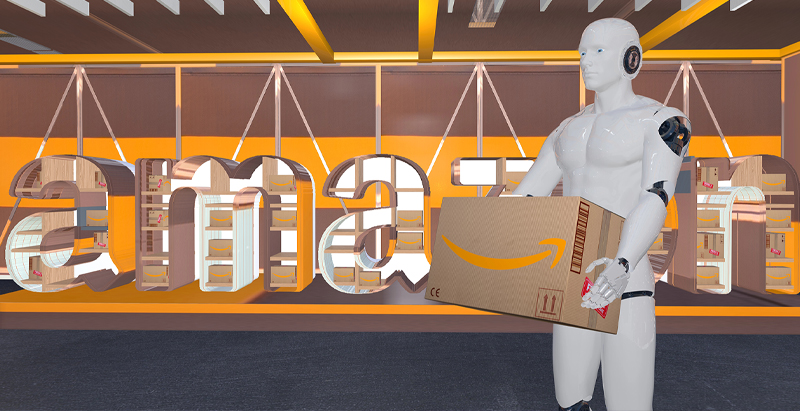
Amazon is going all in on automation, and the fallout could transform the American job market as we know it. According to internal reports, the company is gearing up to replace more than 500,000 U.S. jobs with robots. That’s not a distant scenario. Amazon has already rolled out machines capable of performing tasks that used to belong to warehouse employees, including picking, stowing, and moving inventory. A new robot named Vulcan can even mimic a human sense of touch, making it capable of handling items in ways that, until recently, only people could manage.
Behind the scenes, Amazon’s goal is clear: slash the need for new hires by automating at least 75% of its operations. This would represent one of the most aggressive automation pushes ever attempted by a private company. And because Amazon is the second-largest private employer in the U.S. (just behind Walmart), this shift doesn’t just affect Amazon workers—it sets the tone for the entire labor market.
Amazon says this isn’t about cutting jobs but about “augmenting” them. The company points to the creation of 700 new job categories related to robotics, AI maintenance, and systems analysis. It also claims that automation has improved workplace safety by reducing repetitive or injury-prone tasks. But here’s the kicker: Amazon also admits that it wants to “flatten the hiring curve,” which is corporate speak for “we’ll need fewer humans going forward.”
That may be good for profits, but it’s a huge red flag for workers. The bottom line is this: automation is coming faster than most people are ready for. And if Amazon pulls this off successfully, other companies won’t be far behind. Walmart, FedEx, UPS, Target, any company with a large warehouse or logistics operation is likely already watching this unfold with interest. In tech circles, Amazon’s automation blueprint is seen as a scalable model for other sectors.
This isn’t speculation, it’s already happening. Across industries, we’re seeing similar trends. Logistics companies are investing heavily in robotic sorting and delivery systems. Retailers are turning to AI to handle customer service and inventory. Even white-collar companies like Duolingo and Shopify have publicly said they’re reducing reliance on traditional hires thanks to AI. Meanwhile, a growing number of CEOs are openly stating that corporate headcounts will shrink due to productivity gains from automation.
Here’s where things get real: if you’re in a job that involves repetitive, manual tasks, especially in warehouse, retail, customer service, or transportation roles, your job is likely on the chopping block in the next five to ten years. Maybe sooner.
That’s why now is the time to retrain. Not in five years. Not when the pink slip comes. Right now.
We’re at a fork in the road. On one side are the displaced workers left behind because their roles were automated faster than they could adapt. On the other is an opportunity for millions of people retrained and reskilled for the kinds of jobs automation is creating. Think robot maintenance, data labeling, AI system oversight, cybersecurity, supply chain analytics, UX design, coding, and more.
The problem? The pace of automation is outrunning the pace of retraining. Many workers don’t know where to start or don’t have access to affordable, flexible programs. And many employers still see retraining as a “nice to have,” not a necessity. That must change fast.
If we don’t act, we’re looking at a two-tier workforce: a small group of highly paid, highly skilled tech professionals and a much larger group stuck in low-wage, insecure work or unemployed entirely. Wage pressure will grow, inequality will widen, and entire local economies may be destabilized. Automation could become a net negative, not because of the technology itself, but because we failed to prepare for it.
But it doesn’t have to go that way.
Automation isn’t evil. It’s not the enemy. It’s a tool. If we plan well, retrain smart, and invest in people, not just machines, we can build an economy that works better for everyone.
 Spotify
 Apple Podcasts
 Podbean
 YouTube
 Spotify
 Apple Podcasts
 Podbean
 YouTube