TRANSCRIPT
Speaker 1 (00:00):
Welcome to Manufacturing Talk Radio, your Everything manufacturing podcast with host and veteran manufacturing industry expert Lewis Weiss and co-host Amy Nicklaus. Make sure to check out our catalog of 800 previous shows on YouTube, Spotify, or wherever you’re listening Now, let’s get into the episode.
Cliff Waldman (00:29):
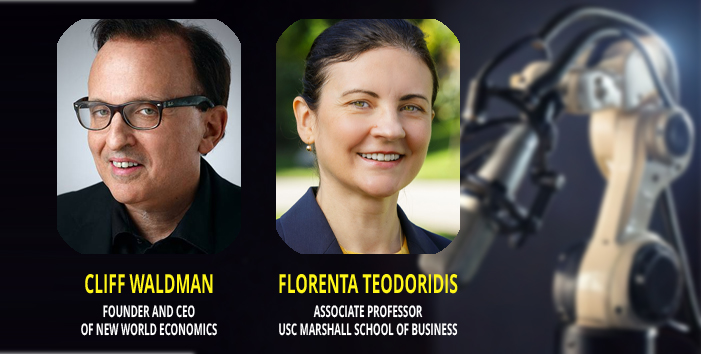
Good Update everybody and welcome to this week’s episode of Manufacturing Think Tank. I’m Cliff Walman. I’m the host of this show, one of many on manufacturing talk radio. Could it be, is it possible that a new technology is and will be hitting the world that’s as profound for manufacturing in the general economy, or perhaps even more profound for manufacturing in the general economy than AI is hard to believe, but we are going to be investigating quantum computing this morning, a technology that uses the deepest insights of theoretical physics and which could have as profound an impact in our world as artificial intelligence is. My guest today is uniquely and impressively qualified to talk about such a difficult and such a challenging and such a captivating topic. FLORETA Tear Ditis is associate professor of management and organization at the Jorge Paulo and Susan Lehman Chair and entrepreneurship at the University of Southern California.
(01:41):
Her main areas of interest, so the economics of innovation and science, creativity and the impact of technology on society. She investigates factors that influence the rate and direction of technological advancements such as research technologies, collaborations and breadth and depth of expertise and the impact of technological advancements such as AI and quantum technologies on business strategy and productivity. She’s also a mentor for quantum technologies, startups at the Creative Destruction Lab, a leading entrepreneurship accelerator. Flo’s work has been published in many top journals such as Management Science, the American Economic Journal, administrative Science Quarterly Organization, science and Strategic Management Journal among others. Prior to her career in academia, she was a project manager and technical consultant for various data-driven large scale business decision-making projects in a variety of industries. Floreta, welcome to the show.
Floreta Teodoridis (02:46):
Thank you so much, cliff, for this lovely introduction. My pleasure to be here. Thanks for having me.
Cliff Waldman (02:51):
Well, I think when you’re dealing with such a highly technical topic, we have to start with just basic definition. So I’m going to ask you what should be the obvious first question. Please explain to our audience what quantum computing is, and specifically I’m going to ask you to explain a bit about the quantum physics that underlies quantum computing.
Floreta Teodoridis (03:13):
My pleasure and I, I’ll have to start by saying that I’m not a physicist, so this is not necessarily my expertise to explain how quantum computing works, and I had the pleasure of talking to a number of physicists and quantum computing scientists and they had explained it to me multiple times and I still feel that my brain is in knot, so I’ll do my best here. Quantum computation refers to a method of computation that relies on principles of quantum mechanics. It basically takes advantage of what scientists have understand about quantum mechanics, and they use this information to perform operations on data. Unlike in a classical computer where the unit of analysis is a bit in quantum computing, the unit of analysis is a qubit. What is the difference between the two? By focusing on the principles of quantum mechanics, a quantum computer with say n qubits can be in an arbitrary state of two of the power of and different states, whereas a classical computer with the same number of bits and bits can only be in one of those two of the power of and states.
(04:25):
So in other words, quantum computers can provide increases in computational power relative to classical computers that are exponential. So the benefit that we expect from quantum computers is a significant increase in computational power. However, quantum computers have their own unique challenges. It’s really difficult to maintain the quantum state of these qubits. They tend to decohere by being exposed to any environmental interference, small vibrations, electrical signals, light, anything you can imagine. So challenging quantum computation is to be able to maintain the quantum state of these qubits and be able to manipulate them in order to perform calculations. A main barrier in scaling quantum computers right now is the ability of scientists to perform error correction on qubits to make sure that the calculations that are intended to happen in this computer are actually happening the way that they are expected. In addition, if we think about quantum computers in comparison to classical computers, quantum computers are probabilistic models in my understanding, so they don’t necessarily give the exact or guarantee the exact same answer every time with each run. So a challenge in this error correction and in making sure that quantum computers work properly is to make sure that multiple runs guarantee the same assets that we get out of a quantum computation.
Cliff Waldman (06:06):
Well, let me ask you this wonderfully describe the physics and the challenges of this, but from the point of view of A CEO of let’s just say of a large multinational manufacturer, let me ask the question that that person might ask. What can a quantum computer, even with all of its challenges, obviously the fact that it can calculate and exist within simultaneous states for me, what does that mean that a quantum computer can do that current computers can’t do? What are its new capabilities that we don’t have right now?
Floreta Teodoridis (06:42):
Great question. There are three categories of problems that quantum computers are expected to help with. The main one is simulating physical systems. So simulating physical system is quite challenging for classical computing because it’s a compute intense operation. What do I mean by simulating physical systems? These are algorithm that helping say material science, material discovery, drug discovery. They are basically simulating, for example, molecular interactions or solid state systems, anything that you can help that it actually gives us new insights about how the world functions and helps us understand how different substances, materials interact to one another. So like I said, it has huge implications for discovering new materials and new drugs. So quantum computers are believed to be uniquely qualified and have a huge advantage over classical computers when it comes to this aspect of simulating physical systems. Another one where quantum computers believe that hypothesized to have a huge advantage is in solving complex optimization problem.
(07:55):
This might be of prime interest for manufacturing the topic that we are addressing today, solving complex optimization problems including a number of things, logistics, for example, fall under this category. It’s a class of problems that have been challenging in classical computing for quite a while because again of the time that it requires to process all the potential combinations necessary to reach an answer. A third category were quantum computers are helpful, are analyzing large and structures data sets. So I mean even with AI right now, as we all know, such problems that we’re trying to solve with artificial intelligence rely on analyzing very large data sets, but classical computers have their limitations. Again, many of us have heard of the high compute requirement from classical computers in order to scale this AI models, quantum computers are believed to be, again helping significantly when it comes to analyzing these large data sets.
(09:01):
In fact, one of the two famous algorithms that was proposed for quantum computers by Grover in 1996 is focusing specifically on analyzing large and structures dataset to speed up search. And one other example, if I am to give one more in these three categories I should qualify. There are two algorithms that have been proposed by scientists, the Grover that I just mentioned for search. So analyzing large and searches dataset, and another one for optimization problems, the shores algorithm, which is basically showing that classical computers can factor large integer faster than a classical computer. And you might ask, why do we care about this? Well, this is the method behind cryptography right now, our method of encryption widely used in society is the inability of classical computers to factor large integer. So if this quantum computer scale properly and apply source algorithm, that will mean an ability to crack basically encryption very fast.
Cliff Waldman (10:09):
Well, let me ask you, very intriguing, and then I think the encryption is going to get a lot of attention from people, but right now what’s the state of quantum ommunity? Are quantum computers generally speaking in use yet?
Floreta Teodoridis (10:23):
There’s a yes and no question to this. So no, when it comes to quantum computers that are able to perform the types of operations that I just described and do so in a way that surpasses classical computers in the speed of computation, so those generally are referred to quantum computers that are fault tolerant and they have a quantum advantage over classical computer. So those know they are not yet in use, they are not yet functional because the scientists are still to solve their error correction problem that I mentioned earlier. My understanding is that the great progress is being made and perhaps this discovery can be around the corner at any moment. But no, we don’t yet have those type of quantum computers. What we do have is more specialized knowledge in capacity quantum computers that can perform specific operations. So specific problems that you can think of them as specialized quantum computers that are performing really well, certain types of tasks but not others.
(11:30):
What we also have, if this is of interest, are some studies that discuss about quantum benefits even in the absence of this fault tolerant quantum computers. So for example, you can think of quantum computers as being able to perform the specialized task faster than classical computers and thus helping some companies that are interested in just those problems. For example, if one wants to analyze some insights about financial transactions or investing in the marketplace and they need an answer in fractions of the second or second, quantum computers can focus on those tasks and provide some advantages, again in fractions of the second or seconds that could benefit those type of companies. We also have what else is happening right now, quantum inspired algorithms. What are those? So scientists through the efforts of innovating in quantum computing that they came up with all sorts of ideas of how to advance increase the capacity of processing of algorithms that run on classical computing. So by just focusing on developing a new hardware, new ideas came to mind of how to improve algorithms that run on our current hardware on classical computing. So this class of quantum inspired algorithms, it’s quite large and growing and there’s a number of large companies that are taking advantage of that right now. IBM, Microsoft, Google, and a number of smaller companies.
Cliff Waldman (13:08):
Lemme focus in specifically on what, you’ve alluded to it a little bit, but I want to really focus on what specifically this new quantum computing technology can do for manufacturing. Now it sounds like potentially a range of things. I mean certainly for large manufacturing supply chain decisions and supply chain optimizations has been vexing and then all the more so given what we’re going through now for manufacturers, can quantum computing solves supply chain optimization problems in a way that classical computers can’t?
Floreta Teodoridis (13:47):
A short answer to that will be yes. That’s the expectation that once we reach a quantum computing that is fault tolerant and provides a quantum advantage, those type of machines will be able to solve all sorts of complex supply chain logistic problems and that should have a significant impact on manufacturing. Even now, my understanding is with the more specialized quantum computers that we have, there are various use cases that could help with manufacturing. For example, there’s this company D-Wave, they have a very specialized type of quantum computers and my understanding is that they have various contracts with companies to help them solve problems such as the port of la. I don’t know if this is still active or not, but it used to be at some point that D-Wave was working with port of LA and obviously logistic problems that are top of their mind.
(14:40):
My understanding in LA here, another thing that can be done, and I mentioned with quantum computers that could affect manufacturing specifically, is material discovery. Again, manufacturing is not my core expertise, but my understanding is that a number of industries depend on discovering new materials and one of the main applications of quantum computers being simulating physical systems implies that it’ll help with discovering new materials and processing ideas on existing materials, but how to improve them. And another third one, which it will help manufacturing, not only manufacturing, but I think it will have a significant impact on manufacturing, is energy and sustainability. Classical computers currently spend a lot of energy in their computation. Quantum computers are expected to use a fraction of the energy necessary in order to return a similar answer or even a better answer, or sorry, faster answer. Let me put it this way because it’s not certainly better, it’s just faster. So energy and sustainability should have a significant impact as well.
Cliff Waldman (15:53):
Well, let me ask you, this is all, let’s look at the other side of the coin. Is it all a good story? I would ask what are the risks to manufacturers if any, of quantum computing
Floreta Teodoridis (16:03):
To this question? I mean, it’s hard to give an answer. It’s hard to have a crystal ball, right? And you give an answer. So I’m going to give you an answer that has to do with more technology in general. So the GIST manufacturers, it’s similar from the risk that we can foresee from all other large scale technologies like artificial intelligence. It depends on how this technology is used. So quantum computers, if we think about it as a technology is a tool. It has certain capabilities, but then in the end it depends how industry players decide to use it, what kind of materials they want to focus on, what kind of complexity problems they want to solve and so on. So it’s not a given. So for example, in ai, there’s this debate or discussion about AI being focused mostly on automating task and displacing people from their jobs or being used to augment the development of certain tasks or helping people in their jobs.
(17:11):
And while of course we can expect some automation, the technology itself doesn’t have any limitations in its ability to augment how people perform their jobs or how companies complete their tasks. It’s a similar consideration with quantum computation by increasing computation that can automate certain processes and that will be great for productivity and it can also be argumenting and that’s also great for productivity. So it remains to be seen. I think it’s a bit premature for me at least to think how that might impact manufacturers, but I would say that manufacturers should think of this technology as not coming from the sky exogenously, but rather a technology where they can get involved early on and learn what this technology is all about and see how they can incorporate it in their processes early on and take advantage of it in early stages. For example, where I am at USC, our quantum group of scientists are going through great efforts to build a quantum ecosystem in Southern California, and one of their main desires is to incorporate in this efforts all sorts of companies that are open to experimenting with quantum early on. I think that’s a wonderful idea because by experimenting with quantum early on, one can understand the risks and benefits and craft their own path from the beginning.
Cliff Waldman (18:46):
Well, you can’t get away. You mentioned ai, you can’t get away from it these days. So one question I would have if it’s even possible right now to answer it is, is quantum computing going to work with AI, particularly in manufacturing in some ways, or do you foresee them sort of augmenting each other’s capabilities?
Floreta Teodoridis (19:07):
Yes, so AI is a software, quantum is a hardware. The expectation is that they will work together and they’ll provide complimentary benefits. At the same time, software for quantum computing cannot be ported directly from classical computing. My understanding is it requires special considerations to develop software for quantum computation, but I don’t think that’s necessarily a barrier. Again, my understanding is there are a number of scientists that are developing machine learning algorithms for quantum computing as we speak. So machine learning being the technology that basically fuel the hype with AI and the advancements with AI right now. So I totally expect that they are going to interact with one another and they’ll be complimentary and enriching in the benefits that quantum computing can provide for companies.
Cliff Waldman (19:59):
Now, it’s often misunderstood that people think that manufacturing is primarily a large company sector. It’s not the overwhelming population of manufacturers have fewer than 50 employees, that you have the big star players, but most of the manufacturing population are small companies. So given that I’m going to naturally ask you how is quantum computing going to shift the balance between large and small manufacturers, particularly, could quantum computing motivate more manufacturing startups, which we clearly need, or is it going to make manufacturing entrepreneurship more challenging? Which one is it or both?
Floreta Teodoridis (20:46):
Interesting, probably both. So again, with this, I would like to tap back into the history of evolution of various technologies since, I mean, it’s hard to imagine exactly what quantum computing is going to do. My take on this is with the prior question is that quantum computing, as with other technologies, is just a tool and it depends how we use the tool, and by we I mean economic actors, how large companies are getting involved, how entrepreneurs are getting involved, policy, et cetera. Historically with large technologies of this kind, and what I mean by this is technologies that generally rely on creating value by enabling downstream applications. Entrepreneurs played a significant role, let me take one more step back. We believe that we scientists in the economics of innovation, it seems like this technology quantum computation is what we call an enabling technology or a general purpose technology similar to the internet, similar to ai, similar to energy a while ago, these type of technologies don’t create much value in isolation.
(22:01):
So if we think about energy, for example, by itself, it doesn’t create value. It needs to be put in an application in a light bulb of some kind. The internet, same thing. It doesn’t create value to have computers connecting among themselves unless there is an application such as email or a search engine from Google and so on. Same with classical computers. Classical computers are just a piece of hardware. They don’t create value unless there’s a complimentary innovation such as software in there create value. Quantum computers are believed to be the same. They don’t necessarily create value by themselves, they need to be applied somewhere. Now, the companies that come up with these applications could be established players, but historically entrepreneurship played a significant role in coming up with this type of applications that create significant economic value. So in the case of internet, there was no such thing as Amazon before and now it’s a huge company.
(23:02):
There’s no Netflix or Google or Meta and so on. So my prediction will be that entrepreneurship, it has a huge opportunity with quantum computing to make a significant impact on manufacturing. And again, I mean it would be great if this could happen sooner rather than later through experimentation. This is something again that we know from this type of technologies, how they evolve. They require a lot of experimentation early on rather than waiting for, let’s say, a full tolerant quantum computer that can do everything and hence solves a lot of uncertainty around this technology. Early experimentation helps these companies learn about unknown unknowns and create value in that manner, and we see that a lot,
Cliff Waldman (23:51):
Right? In this era of disruption, you have to focus, you have to ask a question on the workforce. Many questions about the workforce. I’m going to simply ask you, how is this look ahead? How was quantum computing going to shift the workforce needs of US manufacturers? Will we need more, for example, will we need more of the US manufacturing workforce to have a science background?
Floreta Teodoridis (24:16):
That’s an interesting question. Usually these technologies tend to be upskilled bias. They do require more of a science background, but at the same time as the technology advances, it becomes more user-friendly, so it doesn’t necessarily require that much of a upscale or deep knowledge about the technology itself, how it functions. Again, manufacturing, not necessarily my expertise, and I have to apologize if I say something that is not really aligned, but my understanding is that there seems to be a new appreciation for trade training right now in manufacturing. Is that true?
Cliff Waldman (25:00):
That is very much so, yes.
Floreta Teodoridis (25:02):
Yeah, so I mean, again, if I’m to lean into lessons from prior technologies, it is possible that in earlier stages we might need workers to have more of a sense of what this quantum computation is and how it works, because there’s a lot of uncertainty around the technology and more experimentation is required and so on and so forth. But that’s not necessarily something that is going to hold forever. I do expect that there will be a need for individuals that are more hands-on and not necessarily high skill from the perspective of science. I mean, we see it with some of the startups right now. There’s a large group of entrepreneurs that are entering the space with all sorts of skills that approach this opportunity of quantum computation from various perspectives. Some of them come from strong science backgrounds, some not, but I think engaging in experimentation is key. More so than thinking what kind of skills these people should have in the long run.
Cliff Waldman (26:10):
Let’s move from mainstream more into the public arena. I’m going to ask you please put quantum computing particularly for manufacturing in a competitive context. Let’s look around the world. Are countries outside the US on their way to incorporating quantum computing into their manufacturing processes? What’s happening outside of US borders in this
Floreta Teodoridis (26:37):
Many countries and geographies are very interested in quantum computing, and rightly so, China, my understanding is quite advanced on this. Europe has lots of scientists on it and various organizations that are focusing on moving quantum computation forward. At this point, I don’t think there is much of a focus on one industry versus another as much as a focus on the science of it and trying to scale the efforts in quantum computing research towards a full tolerant quantum computer. But for sure, there’s a lot of effort across different geographies. There are increased concerns as well, my understanding about national security and exports of knowledge in quantum computation, but my exposure to what’s happening shows that scientists are working very collaboratively in moving this efforts forward.
Cliff Waldman (27:39):
Final question, Flo, should the US in your view, be making a public investment in quantum computing? If so, what would be the return on a public public quantum computing investment?
Floreta Teodoridis (27:55):
That’s a big question loaded question. I’ll answer it this way. Again, tapping into what we learned from prior technologies of this type of enabling technologies that rely on large experimentation and collaboration between different economic actors. One aspect that we seem to know from those is that market forces don’t seem to be sufficient for incentivizing significant or optimal, maybe I should say, rates of development of this technology. So policy plays a significant role in it, including investing in this particular technology. What would be the format of that investment? Not necessarily my expertise, but what we do know from lessons from prior technologies is that investments that come from government in conjunction with the marketplace generally have a higher probability of leading to greater welfare returns, so returns for the population at large than if we leave this only to the markets.
Cliff Waldman (29:12):
Floreta. Toyota, you gave us your time. You gave us your expertise. Thank you very much for joining us today.
Floreta Teodoridis (29:20):
Thank you so much for having me. I hope it’s helpful, and
Cliff Waldman (29:24):
Indeed, it was very helpful. Thank
Floreta Teodoridis (29:27):
You. Great meeting you, and I look forward to listening to other episodes.
Cliff Waldman (29:32):
Thank you very much. To our audience, these are new, very cutting edge topics. This is not the last conversation by any means that we’re going to have on quantum computing. We are going back and forth between the disruption of the moment, tariffs and confusion around tariffs to the disruption of the future in quantum computing and what AI may be doing. We will have many more conversations until the next time. I look forward to seeing everybody on the next episode of Manufacturing Think Tank. I’m Cliff Waldman.
Speaker 1 (30:15):
Thanks again for joining us on another episode of Manufacturing Talk Radio. This hosts Lewis Weiss and Amy Nicolaus. Before you head out, make sure to subscribe and leave us a review. For more information about the show and the manufacturing industry, head over to MFG talk radio.com. That’s mfg, T-A-L-K-R-A, DIO o.com.

 Spotify
 Apple Podcasts
 Podbean
 YouTube
 Spotify
 Apple Podcasts
 Podbean
 YouTube