
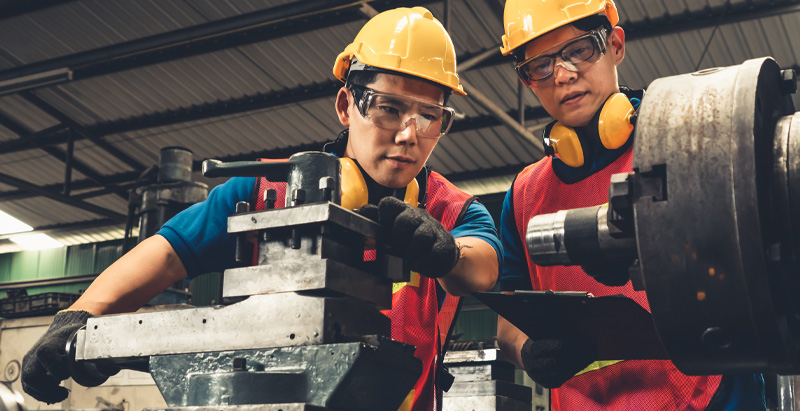
Immigrant labor has long been vital to U.S. manufacturing, especially in roles that are physically demanding, detail-oriented, or involve repetitive tasks. But in 2025, ramped-up deportations and worksite raids are making their presence felt across factories, plants, and workshops, slowing production and spotlighting vulnerabilities in the industrial supply chain.
Let’s start with the big picture. Undocumented workers make up about 4.8% of the U.S. workforce overall, but their share is much higher in manufacturing, particularly in food processing, textiles, and precision assembly operations. In Los Angeles’s fashion-manufacturing hub, for example, more than one-third of garment workers are immigrant laborers. In North Carolina, a parachute-making firm that supplies the U.S. military employs roughly 25% of its workforce under Temporary Protected Status (TPS), many now at risk of deportation.
In June 2025, ICE set aggressive quotas for workplace enforcement, tripling I-9 audits and ramping up raid activity across meat, construction, hospitality, and manufacturing sectors. In LA’s Fashion District, an ICE raid at Ambience Apparel detained around 20–40 workers, prompting production stoppages and worker walkouts. Factory owners report significant disruptions, delayed shipments, last-minute order cancellations, and growing anxiety among remaining staff.
Meanwhile, in North Carolina, the nation’s only two MC-6 parachute manufacturers, critical for military supply chains, warn that loss of TPS-protected workers could jeopardize their ability to fulfill contracts. CEO John Oswald noted that detailed sewing and inspection work “takes 27 steps” and has “little margin for error.” Losing skilled immigrant workers would significantly reduce output.
Beyond apparel and defense, thousands of meatpacking and food‑processing plants saw sharp drops in attendance as undocumented and even documented immigrant workers stayed home in fear. Farmers in Texas, Idaho, and California reported absenteeism so severe that operations “stall or come to a standstill”. A Wisconsin governor asked bluntly: “If suddenly those people disappear, I don’t know who the hell is going to milk the cows”. Similar dynamics are playing out in small manufacturing hubs around the country.
This labor disruption doesn’t just slow assembly lines; it ripples through logistics chains. When stitching, welding, or packaging slows down, finished goods miss shipping windows, and orders are delayed. That means uptime drops and fixed costs cover fewer hours of production, squeezing margins.
And it’s not just anecdotal. Nationally, a Senate Joint Economic Committee study projected that deporting 1.3 million undocumented workers could shrink GDP by 1.2% and total employment by 1.1% by 2028. The American Immigration Council estimates a 4.2–6.8% annual GDP reduction, $1.1 to $1.7 trillion if large-scale deportations occur. Manufacturing-intensive states like California, Texas, and Florida, as well as pockets of New Jersey, would feel these losses most.
Within manufacturing, certain niches are hit hardest. Food‑agriculture links to manufacturing: supply disruptions drive up costs. A Peterson Institute study warned that a sharp cut in farmworker numbers could cause food inflation nearing 10%. Similarly, deportations in garment and precision manufacturing constrain the supply of specialized, time-sensitive products from parachutes to fashion inventory.
Employment dynamics compound the issue. Attempts to recruit local replacements haven’t panned out, and roles in meatpacking or apparel often pay marginally more than service jobs but carry higher risks and repetitive strain. Native‑born workers tend to leave early, raising turnover costs and lowering overall productivity. Employers report that even temporary raids result in longer-term absenteeism, and workers hesitate to return.
Local economies feel the crunch. When manufacturing jobs vanish, entire regions shrink, fewer workers spend, reduced tax revenues, and slowed housing markets. Efforts to increase enforcement, clearing the way for domestic hiring, haven’t yet translated into meaningful job shifts. The jobs remain open, but the labor doesn’t materialize.
Policy clarity matters, too. Conflicting enforcement cues, pauses on raids followed by sudden intensification, leave employers in constant uncertainty. Companies don’t know when workplaces will be targeted, complicating staffing, certification, and compliance planning. This unpredictability hurts planning cycles that depend on steady labor.
In purely statistical terms, these 2025 actions are measurable in lower factory utilization rates, delayed deliveries, and rising operational expenses. They’re visible in frantic hiring ads, empty workstations, and small businesses asking, “Who’s going to do this job?”
In 2025, large-scale deportation efforts are straining U.S. manufacturing, cutting into staffing levels, disrupting timelines, and squeezing regional economies. From garment districts to military‑grade parachute plants, reliance on immigrant labor now meets regulatory shake-ups that ripple through operations and output. The result is greater volatility in a sector built on consistency, affecting everything from product availability to the bottom‑line viability of America’s industrial base.
 Spotify
 Apple Podcasts
 Podbean
 YouTube
 Spotify
 Apple Podcasts
 Podbean
 YouTube