TRANSCRIPT
Cliff Waldman (00:08):
Good day everybody and welcome to this week’s episode of Manufacturing Think Tank with Cliff Waldman. I’m Cliff Waldman. I’m the host of this show, one of many on manufacturing talk radio. We would be committing journalistic malpractice if we didn’t talk about the remarkable events of this week and actually the past few weeks in Washington, we have had a trade in tariff fight that has consumed Washington, that has concerned Wall Street and has created turbulence for most of the world economy. We are going to be one of many conversations on this, but I’m going to take a slightly different tack. Yes, we want to talk about what’s happened in the past few days, but I want to talk about it in a broader perspective. We want to take a few steps back and understand what our competitive challenges are, what our trade challenges are, what our manufacturing challenges are, that’s what it’s really all about.
(01:06):
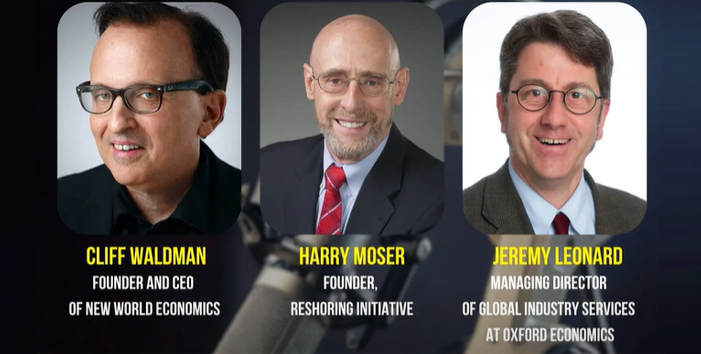
Those are the core issues and then talk about what we should be doing and what we should be doing about it. Through the many years that this show has been on the air, I have said that my guests make the show and I’m just lucky to get them and that couldn’t be any more true with this episode. We have a renowned manufacturing expert and a top economist joining me and I couldn’t be any more excited to have what I know is going to be a challenging conversation with them. As my viewers know, I don’t even make an effort to memorize their bios, but I do weed their bios. They spent a career getting them and they deserve to. Harry Moser founded a restoring initiative to bring 5 million manufacturing jobs back to the US after working for high-end machine tool supplier, GF Charma, is that the way you pronounce it?
(02:05):
Harry Char starting as president of that organization in 1985 and retiring in 2010 as Chairman emeritus. Largely due to the success of the Restoring Initiative, Harry was inducted into the Industry Week Manufacturing Hall of Fame in 2010 and Amess Hall of Fame 2021. He was named Quality Magazine’s 2012 Quality Professional of the Year and FAB Shop Magazine’s Manufacturing Person of the year. Harry participated actively in President Obama’s 2012 insourcing forum at the White House, won the economist debate on outsourcing and offshoring received the Manufacturing Leadership Council’s industry advocacy award in 2014 and the Made in America 2019 shoring Award. He was recognized by Sue Helper, the Commerce Department’s chief economist as the driving force and founding the Reshoring trend and named to the Commerce Department Investment Advisory Council in August of 2019. He testified to the House Commerce Committee and in June 9th, 2022, the Senate Commission hearing on US supply chains and China.
(03:21):
He’s been quoted in all the major media, wall Street Journal, New York Times, Forbes, financial Times, and many others. He received a BS in mechanical engineering and an MS in engineering in MIT in 1967 and an MBA from the University of Chicago in 1981. Jeremy Leonard I’ve known for a long time. He is the managing director of Global Industry Services at Oxford Economics. Since joining Oxford in 2012, Jeremy has been responsible for overseeing the work of the industry forecasting team and managing the operation and output of Oxford economics global industry model as well as related consultancy work serving more than 500 clients. Jeremy’s knowledge and experience span a broad range and let me tell you that that couldn’t be any more true for the years that I’ve known him, including competitiveness and offshoring reshoring commodity price modeling and applied economic research on sectors ranging from biotech to transport equipment to telecoms.
(04:26):
Prior to joining Oxford Economics in 2012, generally we worked for 15 years as an economic consultant for the Washington DC based manufacturer’s alliance where I got to know him for the Manufacturer’s alliance. He provided a variety of economic analysis and forecasting services related to commodity prices, competitiveness, the Canadian and US economic outlooks, as well as acting as a research director for the Institute for Research on Public Policy in Montreal. Jeremy’s Canadian expertise is of extreme value right now, as I’m sure you’ll agree and I’m looking forward to hearing more on the Canadian perspective. A US Canadian dual national. Jeremy was born and raised in Washington DC and educated at the University of Pennsylvania and McGill University where he received his MA in Economic. To my audience, if you have seen either one on any broadcast in the past week or two or have read any commentary on the trade and tariff issue, that should tell you that they are very much part of the conversation. As I said, we’re going to take a slightly broader perspective than just covering the political hubbub and the fights coming in and out of Washington. I’m going to start with Harry. Let’s forget about tariffs for a second and talk about trade related problems right now in the year 2025, what trade related problems or problem or problems does the US really need to solve with policy changes? What are our big faults in the trade area that we need to work on right now?
Harry Moser (06:06):
Pretty straightforward. I think we have last year had a $1.2 trillion trade deficit in goods and there are large supply chain gaps, dependencies on adversaries product categories where US just doesn’t make it anymore and in many cases the product or the material is necessary for military and for generally for the economy, for manufacturing, we have an inadequate defense industry capacity. Various studies have shown if we had a war over Taiwan, we’d run out of everything in two weeks and it’d be over and we have an inadequate civilian capacity. So like in World War ii, we were making all kinds of things and people could shift that factory or those people into the defense effort if needed, but we don’t hook enough of that surrounding civilian capabilities. So for a variety of reasons it’s not pretty.
Cliff Waldman (07:02):
Jeremy, the second question bounces off of that as a point of important economics right now, does our trade deficit with the world deficit, is that tantamount the saying that we are losing on the global front? Isn’t the trade deficit to some extent a reflection of our wealth and our ability to track capital or is it signaling a problem?
Jeremy Leonard (07:25):
I think there’s a couple of ways to answer that. I mean one of them does follow onto what Harry said and I think I would broadly agree with Harry on the first question about particular shortcomings and gaps in the supply chains in certain sectors. I think if you take the question though at a very broad macroeconomic level and say is it a macroeconomic level, the trade deficit, an indication that we’re losing something or that we’re worse off? I don’t necessarily think that’s the case at a macroeconomic level. And I think the reason I would say that is simply because in many ways what is the trade deficit? Well, it means we’re purchasing more than we’re sending abroad. And so purchasing things that typically are lower price than what can be produced here is clearly providing benefits to consumers. Now that’s abstracting from issues around supply chains and the need to be able to produce things that are critical for national security.
(08:21):
But at a very macro level, there certainly isn’t argument to say it doesn’t necessarily mean that we’re losing because consumers have benefited greatly from the fact that we have been importing very large amounts of things. We look at the inflation rate over a period of very long time. A lot of that low inflation was in fact driven by the fact that we had this influx of imports. And I think the other thing to think about, and you sort of alluded to it when you asked the question is that of course the flip side of a trade deficit is a surplus in something because we economists know that everything balances out. And what that means is that there is a very large influx of capital and money. And if you look at the capital account of the trade accounts, yes, it’s in surplus. Now again, that can be interpreted in very different ways.
(09:05):
Some people will say, well, it just goes to show that foreigners are buying up the United States. And in some sense, in an accounting sense that’s true. But one of the things that money brings in is first of all, it does show that foreigners do see the US as an economy with very strong fundamentals and strong prospects for growth. That’s what’s attracting the capital. And the second thing, and this is more about the direct investment, is of course when a company establishes operations here, which is actually something that it would probably be a success in the eyes of the administration, there’s a huge amount of technology transfer and knowledge sharing and that actually can provide benefits to the US economy itself. And I’m sure Cliff, you’re going to talk a little bit about innovation later on down the line. So I think in a very macro perspective, I don’t think you can simply say that because we have a large trade deficit, it means that our economy is fundamentally weak.
(09:58):
I would also point out that typically when you see very strong expansions in the us, you’ll actually see an increase in the trade deficit because what that means is that consumers are spending more on everything including things made here at home and also things that are made abroad. And you will often see imports increase if the US is growing faster than the rest of the economy. It means that US consumers are in a stronger position, they’re buying more things and that just by in and of itself will tend to increase the trade deficit. And I certainly wouldn’t want to say that when the US is expanding faster than other countries because the trade deficit is increasing, that means somehow that the US economy is not doing well. But I do recognize there are clearly nuances to this because we can look at different sectors like the defense sector, like certain things like steelmaking, where certainly I wouldn’t necessarily disagree with the argument that we do need to focus our efforts there.
Harry Moser (10:50):
Cliff, if I could
Jeremy Leonard (10:51):
Please.
Harry Moser (10:52):
Okay, so from our viewpoint we would call on Ray Dalio and his changing world order, which I think you two know various determinants that determine whether an empire or country is on its way up peaking out or in decline. And if you look at the factors that say that a country’s gotten done at the top or it’s in decline, it includes many of the things that we’re talking about, competitiveness, debt, printing money, wealth gaps, less productive. Most of these things are the things that either a cause or the result of the trade deficit. And therefore from a broader sense, from an even higher sense than I’d say Jeremy was looking at, I’d say the way it’s going is the sign of a country or an empire, whatever you want to call the US past its peak decline, not facing good times ahead. So we believe it’s necessary to reverse that trend and strengthen all those factors.
Cliff Waldman (11:47):
The one thing I’m going to throw into the debate here is that manufacturing tends to have a natural evolution with the development of the broad economy. Many of our trading partners are in earlier stages of development than we are. And in countries and earlier stages of development, and Jeremy, you can correct me if I’m wrong, tend to have a larger share of their output coming from manufacturing. Because what manufacturing often does, particularly for poorer economies is that it transitions developing economies from subsistence wages and agriculture moves the workforce into the more productive industrial sector, allows the economy to grow, gain wealthy, and then you move from an industrial economy to a post-industrial economy. So there’s kind of a natural evolution and part of the issue is here is that the dissonance happens when we trade with economies that are in different stages of development. They’re going to have different roles and different relative sizes for manufacturing.
(12:52):
So I think that adds a bit of an interesting complexity to the story. Harry, let me ask you, we talked about trade. Let’s now move more specifically to manufacturing. Although manufacturing is a trading sector, tradeable goods sector, if we’re sitting down and looking at the health, taking the temperature of the manufacturing sector, giving you a physical, what numbers right now suggest to you that, hey, our manufacturing sector needs some policy help or some work? What are the numbers that concern you the most coming out of US manufacturing? Let’s suggest we need to give a shot of something to it.
Harry Moser (13:30):
It’s not so much the trend because the trend is sort of stable at a low level. It’s our self-sufficiency in manufacturing. It’s the fact that we, even in agricultural products, we import more than we export. So we were used to be the bread basket of the world and now we’re not even self-sufficient in terms of food. Skilled workforce is a significant problem and one reason we have problem with skilled workforce is the image that manufacturing is in decline. If the potential workers all believe that there’s not going to be a future in manufacturing, then the smart kids aren’t going to go into manufacturing, then we’ll get even less competitive than we’re today.
Jeremy Leonard (14:10):
I would agree with Harry on the skills and workforce. It’s a hard thing to measure. It’s very difficult to get an accurate handle on the stresses, but I do think they’re, there are a couple of things that I’m quite worried about and one of them is around manufacturing productivity because if you look at the level of output per hour in manufacturing in the us, you see an upward trend until about 2010. And since about 2010, that trend has been flat for basically 10, 15 years. This is very different to the time when I was working with you Cliff at the manufacturer’s alliance when we were in the middle of a manufacturing renaissance. That is very concerning to me because in my mind that more than the trade deficit is illustrative of these competitive pressures, it means that manufacturers are not becoming more efficient. And if you’re not becoming more efficient, whatever happens to the trade deficit in terms of the macroeconomic factors, you’re still going to be struggling in foreign markets.
(15:02):
So issues around that are very important. And the second one is around regulatory compliance and regulatory costs. This again, is very difficult to measure through time. In fact, back when I was working with EU Cliff, I did quite a lot of work. This would’ve been 15, 20 years ago. And even then the costs of class action suits torts. And since then I would argue that there’s been quite a lot of additional regulation around environmental compliance or climate compliance. Now we can argue about whether that’s good or bad, but I think the issue is that with every new regulation, we’re not seeing other regulations go out the door. So there’s just a lot of compliance that needs to be done. And there’s something quite interesting before the show, I just happened to look at manufacturing growth in that period of 20 17 18 when there was a very decided move towards deregulation. And what you saw was not surprising, which was a growth acceleration in manufacturing. It didn’t last because of COVID, but I think that is one area it’s very hard to quantify, but I think it’s one of the most important obstacles to the success of manufacturing more broadly.
Harry Moser (16:06):
I agree with Cliff very much on the productivity issue. 0% increase over 15 seems impossible that it could be so low. And part of the problem is that in contrast to that, China is reporting 6% annual productivity increases, which was one thing when they were starting on the dirt floor. But now they’ve got factories that in many cases are newer than ours, more automated than ours, and so they’re still there with wages that are a third of ours and they’re becoming more productive than we are. It’s a big issue. So we see automation as a necessary but not sufficient condition. If you automate just very aggressively, pretty much you can get a lot of the labor out, maybe you can cut half the labor out or something like that. But the Chinese price on average is 60%, 65% of the US price. So if you’ve got all the labor out, let’s say at the assembly plant, you can’t get enough labor out to make up for the difference. And so we believe that we have to automate much more aggressively than we are, but doing that alone is not sufficient because it’s like Alice in Wonderland where you have to run as fast as you can just to stay even.
Jeremy Leonard (17:17):
And it kind of comes back cliff to that point about the natural stages of evolution because in some sense through the 1990s, I would argue that manufacturing was almost the victim of its own success and we saw a declining share of employment in manufacturing. But to Harry’s point, we did not see the same concomitant decrease in manufacturing share of the economy. Yes, there was a slight decrease, but what that was doing, it meant that manufacturing was growing in absolute terms and it was releasing labor resources to be able to create some of these sectors like IT services that basically didn’t exist 30 years ago. So it’s in some sense that’s a natural progression, but if you have that situation where you have manufacturing declining as a share of employment and you have no productivity, then you’ve got a problem. Alright,
Cliff Waldman (18:04):
Let’s now turn to the drama of the moment. President Trump came in for his second term for decades now ostensibly since the 1970s, early 1980s, he has had the thesis that a large part of the problem is that the US is being treated unfairly on the trade front and thus the, and he’s concomitantly believed that the answer to all this is tariffs and reciprocal tariffs and something that has amounted to a significant trade war. Let’s give him the benefit of the doubt. Let’s examine that and I want to hear very much here from both of you on this. Jeremy, I’m going to start with you. What’s wrong with his solution? Why not use tariffs to solve some of these problems? What’s wrong with that?
Jeremy Leonard (18:52):
Well, I mean the main issues I see with tariffs are certainly in the short run to the extent that US consumers and producers are dependent on imports. Some form of price increase is going to come through. Now that’s going to depend on the degree to which the tariff can be passed through. It depends on the margins of the seller, it depends on the elasticity of demand, it depends on a whole host of things, but prices can only move in one direction and that’s up. So there will be upward inflationary pressure of some amount. We don’t know what it’s going to be. We at Oxford economics don’t think it’s going to be massive. It’ll be probably a percentage point or two on the CPI for a couple of years. So it’s not a hyperinflation, but in nonetheless it mean it complicates the fed’s job. But I think the other factor is that hypothesizing that the tariffs have their intended effect in the sense that import there is import substitution for domestic products who are now protected from foreign competition.
(19:49):
Well, if you’re protected from competition, well then you’re going to have less of an incentive to innovate because you really have no need to innovate because your competition has been reduced. In the case of China, if we’re talking about 150% tariffs, that’s a pretty big hit to Chinese product competitiveness. And I have to emphasize this is not just about a few different types of products. This is across everything that China exports. So that’s always a risk of tariffs is that it discourages innovation on the part of domestic manufacturers, which could potentially mean reduced product quality for American consumers. It could potentially mean coming back to this flat productivity, if you have no need to increase your competitive posture against foreign competitors, then what’s going to happen to manufacturing productivity? And as an economist, I know that what the fundamental driver of increases in real wages comes from productivity.
(20:41):
It comes from the fact that workers are delivering more value. I think those are the risks. Now, there have been cases, and of course the goal of tariffs is to protect infinite industries, and I think there is an argument for that. Certainly South Korea provides quite a good example of that in the 1970s and 1980s. And some have argued, and it’s not always easy to argue against them that the Korean economy has been transformed because there were certain protected sectors. We can look at the Biden administration’s tariffs on electric vehicles. Again, whether or not you agree with the energy transition or the EV transition, the crux of the economics is that it’s an infant industry in the US and to the extent that we need to build up economies of scale and production capacity, certain targeted tariffs in certain sectors that want to be developed might accomplish what they intend to do. But I think from a broader perspective, the two key disadvantages are on through the price channel and through the innovation channel.
Cliff Waldman (21:42):
How are we saying question to you? What’s wrong with President Trump’s prescription, our related prescription
Harry Moser (21:48):
First, if you think about it really as an industrial policy problem, how do we get manufacturing? How do you achieve his objective of bringing manufacturing back then? He didn’t I say he didn’t pick the right solution? I think a better solution, of course you have to understand the root cause of the problem. Our manufacturing costs being 30, 40%, 50% higher than China’s 10, 20% higher than most other developed countries. Therefore, we’re not price competitive companies go abroad to find the product. And a better solution would be to get the dollar down by 20%. There’s methodologies like the market access charge that would achieve that and that 20% premium in the dollar because we’re the reserve currency is really the underlying cause of the problem and we’re not attacking that underlying cause. And so we recommend getting the dollar down gradually, quickly. I can’t figure out which is a better way to do it, but getting the dollar down because then one of the benefits of that is with a lower dollar, imports are going to be reduced and exports are going to be increased. Whereas with tariffs, imports are reduced, but exports are reduced also because of the retaliatory tariffs from the other countries. So for us, the currency is clearly a better problem. And I’d say if we continue with our $2 trillion budget deficits and trillion dollar trade deficits, eventually the dollar’s going to come down.
(23:09):
And if you know it’s going to come down in whatever, 10 years or 15 years and the country will have been even more hollowed out and weakened in debt and everything else, why not do it now and take some pain now, get it over with and create that strong industrial base to make things happen. Another point on, Jeremy mentioned innovation, and there’s been a lot of work by two Harvard Business School professors, Pisano and she who show that there’s significant benefits for innovation of having engineering near manufacturing because they can work together to optimize the product design and the process of making it. And when you pull ’em apart, when if you allow so much of the manufacturing to be done half a world away, you lose the benefits of that. And that’s impactful. And the result is that eventually knowing that the companies will shift their engineering and RD over to the other country where the manufacturing is, and now you’ve lost innovation also. So do we think the best way to achieve innovation is to reshore?
Cliff Waldman (24:09):
I’m going to take the question down to the specific and I’m going to combine the next two questions for the sake of time. It seems to me that in terms of solutions, while President Trump is fighting and dealing with tariffs, if we really want to bring manufacturing back and we really want to strengthen us, and in some ways this is an obvious question, but I want to hear specific comments. For all the years that I have dealt with manufacturing executives, manufacturing CEOs, the biggest problem, the biggest complaint that I keep hearing over and over again is about the workforce. Part of it’s demographics is just there’s fewer people, but they are constantly complaining about not being able to fill a range of jobs. So it seems to me we have to be that Washington, while it’s fighting now ought to be working on dealing with the competitiveness, competitiveness, global competitiveness of the US manufacturing workforce. And secondly, I often feel that we tend to outsmart ourselves with technology issues. We fear that ai, for example, is going to lose jobs for us, but then our competitors invest more in AI than we do, and we end up losing jobs for that reason. So it seems to me we ought to be working while we’re working on competitiveness, we need to be working on workforce competitiveness and technological competitiveness. So it’s an obvious point I think. But Harry, would you like to add a little bit to both of those concerns?
Harry Moser (25:46):
Yeah. Workforce is our number one issue. Our objective is to balance a good straight deficit, 40% increase in manufacturing, 20 or 30% more people, millions. Millions more people working. And we don’t have enough now. So if you really succeeded with the tariffs or with reshoring in general and you don’t have the people, it’s not going to work. We just did a survey of 500 manufacturers and we asked them to rank or to show what the impact would be of various Trump policies. And for example, for 15% tariffs universal across everything they said they’d bring back 24% of the work, but for a better and sufficient quantities skilled workforce, they said they’d bring back 30% of the work. They put a higher priority on skilled workforce than on tariffs or currency or regulation or anything else that you could find. So we believe it’s unambiguous that we need a dramatically improved workforce. And what it’s going to involve is significant flows of students coming out of high school instead of going on to university and dropping out or eventually working at Starbucks, going into tool making, welding, precision machining, engineering, something where they can succeed and have a career.
Cliff Waldman (27:01):
And those jobs pay well as well.
Harry Moser (27:03):
Yeah. So we proposed that we need a shift from a college for everybody or a degree for everybody over to a good career for everybody.
Jeremy Leonard (27:14):
I agree with that completely. And in fact, I’ve lived in the UK for almost 13 years, and one thing that there’s a lot that isn’t going for the UK economically, but one thing that they have got their finger on is these, what we call over here apprentice programs. And it’s exactly what you speak of Harry. It’s basically the people. University track isn’t for everyone. And certainly if you look at it from a labor force requirements perspective, it definitely isn’t the path that any economy needs in the US and I would say even in other countries because this skill shortage in manufacturing is actually, it’s a worldwide phenomenon. Exactly. And it’s not that we don’t have the warm bodies because the US demographic profile actually looks a lot better than most other countries, including a lot over here in Europe. And if we can just get policies focused on that, and I know that individual companies are doing this, but there’s not really to my knowledge, a policy framework in the US that looks at this.
(28:10):
There’s a lot of talk about what do we do about student debt and the cost of a university education. My own son is in an apprenticeship program and they’re a win-win for everyone because tuition is very low. The company is going to get some value out of the person. And as you say, cliff, there’s a nice salary potential down the line. So I think I agree with you, Harry, that’s the number one for me. I think that others are sort of technology is really about sort of taking another look at some of the policy prescriptions in place. Because innovation, I was very happy that the r and d tax credit for business has been made permanent for the last 10 years. I believe it’s still an incremental credit. And so that creates a few perverse incentives. If you’re completing a major research program and then you want to move in a different direction, well, you may not necessarily get the tax break. So I think there’s some things around those kinds of things that policymakers could look at. But the number one for me is just aligning your educational strategy to the needs of the labor force. And let’s not forget what Harry said at the outset, which is the image of manufacturing. Manufacturing jobs have always had an image problem. I think it’s improving over time, but we still need to push on that. Working in a factory is nothing like Charlie Chaplin’s modern times or anything people see in films.
Harry Moser (29:27):
We see the government as a major part of the problem because I go on their department of labor website, department of Education, if it still exists and you see million dollars more lifetime income versus a high school degree, number of degrees income going up. And I’ve been trying to get them to show to put in the average income of an apprentice graduate and show that it’s the equivalent of a bachelor’s degree. And I can’t get them to put that in because they’re so beholden to the universities to help the universities fill the football stadium.
Cliff Waldman (29:56):
Yeah. Final question for Harry Moser and Jeremy Leonard, and it’s a bit of an ominous one, gentlemen. This is sort of a macroeconomic question. Normally in periods of crisis, and I think everybody would agree that over the past week or two we’ve been in a period of crisis, the stock market and the bond market even more so has been telling us that normally in periods of crisis, particularly market crisis, the dollar becomes a safe haven, a port in the storm for safety, but not this time. This time, oddly, the dollar has been depreciating as the tension and the market nervousness is ratcheted up. Harry, let me start with you. What’s that telling us why?
Harry Moser (30:40):
Well, I had two thoughts. One is that maybe the administration is intentionally using the tariffs to create this sense of uncertainty about the US and wind up with a lower dollar, which achieves my lower currency scenario. It’s possible they’re clever people down there. They could do that, or maybe the market sees that the tariffs are causing the US to lose some of its economic power, some of its dominant, some of its reserve currency capabilities, et cetera, or safe haven. And therefore they no longer have that attraction to the US even in this time of instability. But it’s our instability. So those are my two thoughts,
Cliff Waldman (31:20):
Jeremy. Is that falling dollar a vote against of no confidence in US economic policy?
Jeremy Leonard (31:27):
Well, certainly on the macroeconomic interpretation of it, that would be my interpretation because you’re absolutely right that the dollar being a flight to safety, you tend to see the US treasury market strengthen. That’s not what we’ve seen. We’ve actually seen a significant weakening in the bond market and historic increases in yields. I think that to me is the biggest kind. I wouldn’t call it a red flag. I’d call it maybe a yellow light. I would tend to think that it’s the latter interpretation that Harry mentioned that this is a sign that there is some unease about the US as an honest broker on the policy front and the extreme uncertainty that is coming. And then I also try to think of it in terms of fundamentals because obviously the value of the dollar in some sense is a function of demand for the currency, and part of that demand is coming from demand for US goods.
(32:18):
And being from Canada, I know that there’s a lot of talk about boycotts. I don’t think this is having any impact around the margins, but I think to the extent that there is a loss of confidence in the US’ capability to grow briskly in the next couple of years, that’s the signal. And I think it’s just the market’s way of saying that the end result of this trade war with China is going to be lower growth, not only in China, which may be the administration will like, but also in the US and most other places in the world.
Cliff Waldman (32:48):
Harry Moser, Jeremy Leonard, you gave us your time, you gave us your expertise in a critical moment. Thank you so much for joining us today at this important moment in our history. To our viewers and listeners, this story is going to continue and it’s going to expand and there’s many moving parts of this story, and we’re going to keep following it, and we’re going to do everything we can to get you to understand as we did today with two wonderful experts, the real issues, the core issues that are causing a great deal of turbulence. With that in mind, until then, look forward to seeing you in the next episode of Manufacturing Think Tank. That’s a wrap.
 Spotify
 Apple Podcasts
 Podbean
 YouTube